


Increasingly, the answer is that recruiter effort shifts, from scanning and filtering to evaluation and decision-making, where it creates the most value.
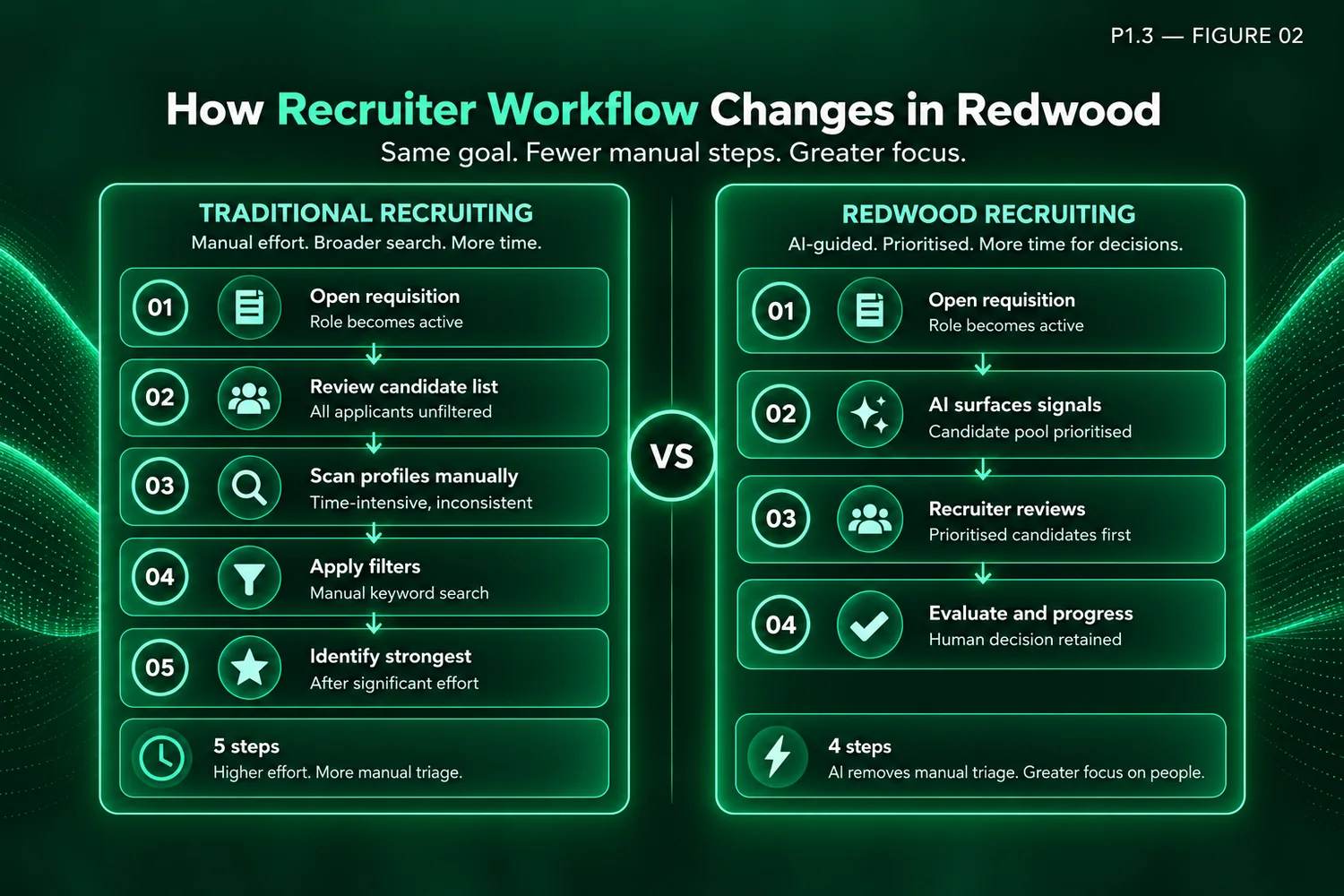
In traditional recruiting workflows, identifying the most relevant candidates often requires significant manual scanning. Recruiters open requisitions, review long applicant lists, apply filters repeatedly, and build their own picture of candidate quality before meaningful evaluation can begin.
AI-assisted capabilities in Oracle Redwood begin to shift that effort earlier in the process. Instead of spending time locating patterns within large applicant pools, recruiters can start with insight, allowing their time and judgement to focus on evaluation and decision-making.
In the first article in this series, I explored why Redwood adoption stalls when organisations focus on enablement rather than behavioural design. In the second, I examined how employees and managers begin HR work when navigation is no longer the primary entry point.
This third and final article in Phase 1 completes the picture by looking at recruiting, where AI-assisted capabilities change not how a transaction starts, but how a recruiter decides where to focus first.
In this article, I’ll explore:
- Why recruiting is structurally different from other HR domains, and why AI fits earlier in the process
- How Redwood reshapes how recruiters interact with candidate pipelines
- Which AI‑assisted capabilities in Oracle Recruiting Cloud support earlier prioritisation
- How recruiter accountability is maintained while AI guides attention
- What must be in place to ensure consistent and controlled use of AI-assisted capabilities
Why Recruiting Is Different from Other HR Domains
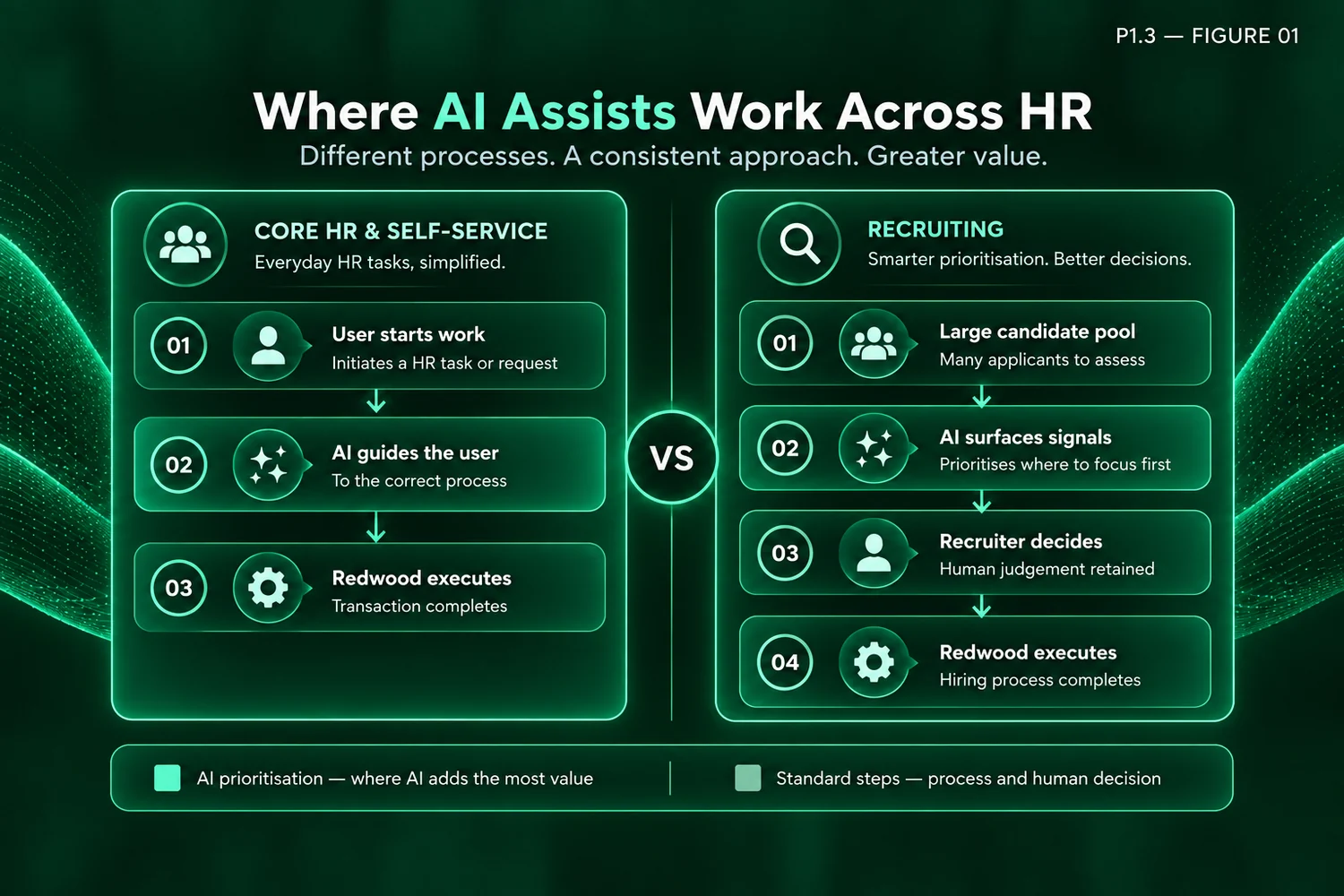
Across Phase 1, a consistent pattern has emerged. In Core HR, Redwood and AI can increasingly help HR Specialists start the right transaction. In self‑service, Redwood and AI helps employees and managers begin the right process without needing to understand system structure.
Recruiting differs from other HR domains because the primary challenge is prioritisation rather than navigation.
A recruiter reviewing 150 applications is deciding where to invest time first, which candidates warrant review, where engagement is time-sensitive, and where effort is likely to produce value.
These decisions are comparative, iterative, and often time-critical. In high-volume environments the real cost is not time per application but accumulated delay across large candidate pipelines.
This makes recruiting a natural domain for AI-assisted insight before execution, shaping where recruiter attention goes before decisions are made.
Swipe horizontally to inspect this figure.
Redefining Where Recruiter Work Begins
Traditionally, recruiter work starts with lists and queues. Requisition-level candidate lists. Application grids sorted by submission date. Manual filters applied repeatedly as recruiters try to extract meaningful insight from noise.
These views require insight to be built manually.
In Redwood, this shifts toward guided attention, where the system surfaces indicators that help recruiters understand the relative quality and urgency of what is in their pipeline before they open a single profile.
The move from list-driven to signal-guided interaction is subtle, but its impact on recruiter capacity and candidate experience is significant. Strong candidates are engaged sooner. Lower-alignment applications do not absorb disproportionate time. Recruiter effort is applied where it matters most.
Once attention shifts from scanning lists to interpreting these cues, the practical question becomes: which AI capabilities in Redwood actually enable that shift?
In practice, AI assistance in Redwood recruiting appears across three stages of recruiter interaction. Some capabilities help identify which candidates deserve attention first. Others help recruiters interpret candidate information more quickly. And some reduce the effort required to complete routine recruiting activities such as candidate communication.
Together, these capabilities shift recruiter effort away from manual scanning and toward structured evaluation and decision-making.
Swipe horizontally to inspect this figure.
AI‑Assisted Capabilities That Change Early‑Stage Recruiting
Rather than introducing a single recruiting agent similar to the Concierge agents used in Self-Service, Oracle embeds AI-assisted capabilities directly within Redwood recruiting experiences. These features integrate into the recruiter’s workflow, surfacing intelligence at the point of decision. The following examples highlight three AI capabilities currently available in Oracle Recruiting Cloud.
AI‑Assisted Candidate Matching and Relevance Signals
(Job Application AI Rating) 25B
Oracle Recruiting Cloud provides AI-assisted candidate relevance signals through Applicant AI Ratings and Intelligent Matching in the Redwood recruiting experience.
These capabilities analyse candidate profiles against job requisition requirements and surface structured indicators directly within the recruiter’s candidate list. The system compares candidate education, experience, skills, and profile information against the requisition and generates ratings that help recruiters quickly identify stronger alignment across large applicant pools.
Recruiters can configure the candidate list view to display AI-generated ratings for areas such as:
- Experience Rating
- Profile Rating
- Skill Rating
- Education Rating
These ratings are generated using AI Apps models used by Oracle Intelligent Matching, which evaluate the similarity between candidate profiles and job requisition requirements.
The ratings appear directly within the Redwood candidate list, allowing recruiters to compare candidate alignment before opening individual profiles.
A recruiter opens a Finance Manager requisition with 140 applicants.
Within the Redwood candidate list, Applicant AI Ratings highlight candidates whose experience, skills, and education align more closely with the requisition requirements. The recruiter can quickly identify stronger candidates and begin reviewing those profiles first.
AI-assisted ratings help recruiters:
- Prioritise review effort across large applicant pools
- Identify stronger candidate alignment earlier in the screening stage
- Reduce time spent manually scanning lower-alignment applications
Recruiters remain responsible for structured evaluation, interview decisions, and candidate progression through the hiring workflow.
2. AI-Assisted Candidate Profile Summaries
(Candidate Work Summary in Job Applications) 25A
Oracle Recruiting Cloud provides AI-generated candidate work summaries within the Redwood recruiting experience to help recruiters review candidate profiles more efficiently.
When viewing a job application, recruiters can access a Work Summary that uses generative AI to summarise key aspects of the candidate’s work experience and responsibilities. Instead of scanning lengthy CV content, recruiters see a concise overview of the candidate’s professional experience.
This helps recruiters understand a candidate’s background more quickly while reviewing applications within the recruiting pipeline.
A recruiter reviewing several applications for a Finance Manager role opens a candidate profile in Redwood Recruiting.
The Work Summary provides a concise AI-generated overview of the candidate’s previous roles and responsibilities, allowing the recruiter to quickly understand the candidate’s experience before reviewing the full CV.
AI-generated work summaries help recruiters:
- review candidate profiles more quickly
- understand candidate experience without scanning long CV content
- focus evaluation effort on candidates who warrant deeper review
Recruiters remain responsible for assessing candidate suitability and progressing applicants through the hiring process.
3. Generative AI for Candidate Communications
(Compose Email and Text Messages Using AI Assist) 24C
Oracle Recruiting Cloud includes AI Assist capabilities that help recruiters generate candidate communications directly within the Redwood recruiting experience.
When communicating with candidates, recruiters can use AI Assist to generate draft email or text messages based on the context of the recruiting activity. The assistant can produce suggested content for common recruiting communications such as interview invitations, follow-up messages, or requests for additional information.
Rather than composing these messages from scratch, recruiters begin with an AI-generated draft that can be reviewed, edited, and sent within the existing recruiting workflow.
This reduces the time required to prepare routine communications while ensuring recruiters maintain full control over candidate interactions.
While reviewing shortlisted candidates for a role, a recruiter needs to contact several applicants to request availability for interviews.
Using AI Assist, the recruiter generates a draft message inviting candidates to schedule an interview. The system produces a suggested message that the recruiter reviews and edits before sending.
AI-generated communications help recruiters:
- draft candidate messages more quickly
- maintain consistent communication across recruiting activities
- reduce time spent composing routine outreach messages
Recruiters remain responsible for reviewing and approving all communications before they are sent to candidates.
From AI Insight to Structured Hiring Execution
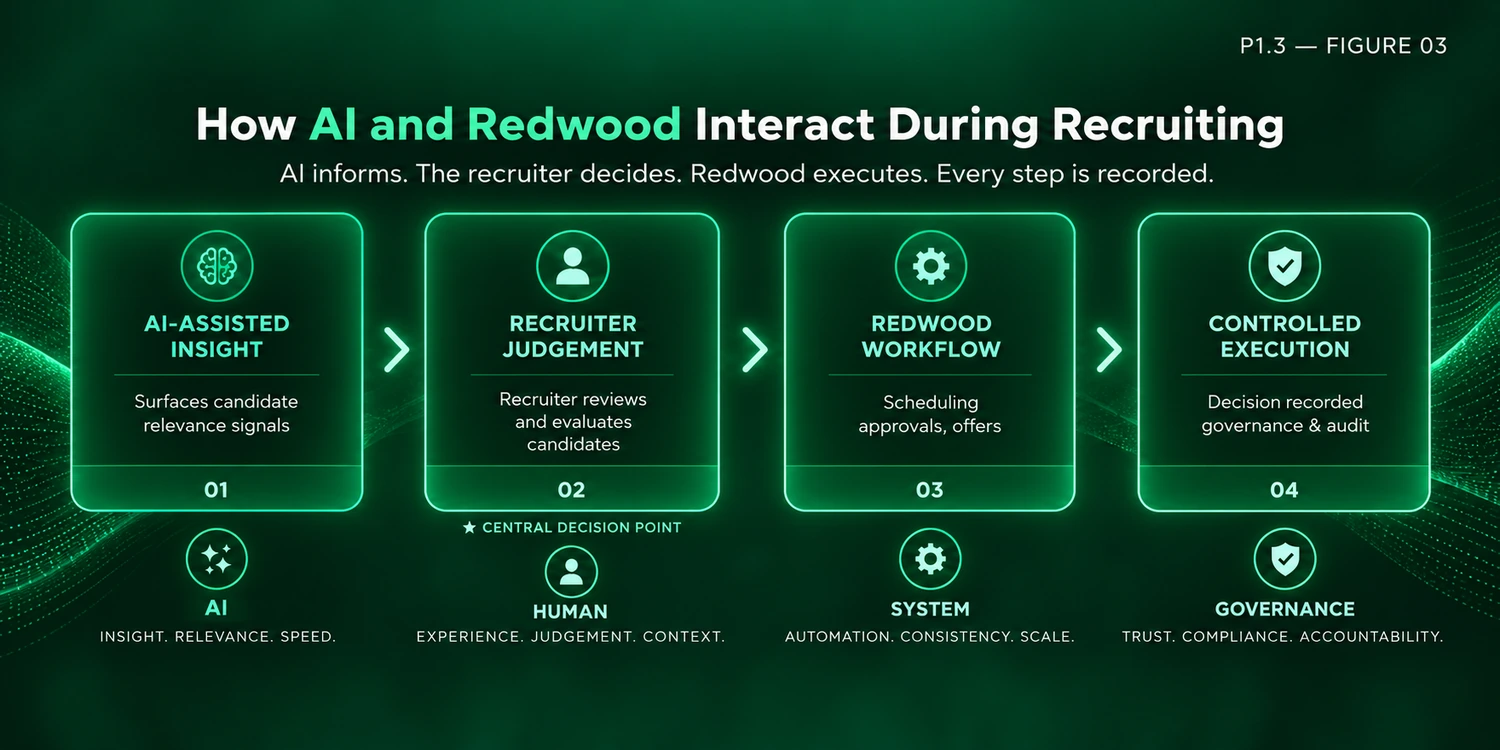
AI capabilities in Oracle Recruiting primarily assist recruiters before and during candidate review and pipeline management, helping surface insights, recommendations, and contextual guidance. Once a recruiter takes action, such as advancing a candidate, scheduling interviews, or initiating an offer, the configured Oracle Recruiting processes and workflow approvals govern the next steps.
Within the Redwood Recruiting experience, these actions trigger the standard recruiting workflow framework. Interview scheduling, offer approvals, and hiring transactions follow the organisation’s configured recruiting processes, including role-based permissions, approval chains, and audit tracking.
This ensures that while AI can assist with prioritisation, matching signals, and contextual guidance, the formal stages of hiring remain governed by structured workflows and organisational controls.
The interaction pattern is consistent with the model seen across other Redwood HCM experiences:
AI-assisted insight → Recruiter judgement → Recruiting workflow → Controlled execution
This mirrors the pattern established across other HCM areas such as Core HR and employee self-service. AI influences how users begin and prioritise work, while the Redwood experience provides the interface through which structured processes are executed.
In practice, the effectiveness of this model depends on design, ensuring that the transition from AI insight to governed workflow execution remains seamless for recruiters managing active hiring pipelines.
Swipe horizontally to inspect this figure.
Reducing Recruiter Fatigue Without Reducing Control
High-volume recruiting environments create a different kind of operational pressure. Recruiters managing multiple requisitions must maintain consistent attention across large candidate pools, often with limited visibility of which applications deserve priority.
The result is familiar: delayed reviews, over-reliance on filters, inconsistent shortlisting behaviour, and strong candidates disengaging before meaningful engagement occurs.
AI-assisted indicators help narrow the initial focus window by surfacing candidates whose profiles show stronger alignment with the role. Recruiters can begin evaluation earlier, applying their judgement where it matters most.
Importantly, recruiter accountability does not change. Decisions remain transparent and auditable, while AI indicators remain visible within the recruiting interface.
Implementation Considerations
Avoiding AI as an Automated Shortlist
The most significant risk in AI-assisted recruiting is not technical. It is interpretive. When recruiters perceive AI signals as shortlists rather than prioritisation indicators, the structured review process can break down.
The pattern is consistent across Phase 1. In Core HR, AI risks becoming a faster way to locate pages without careful design. In Self-Service, it risks becoming an accelerated form of search. In recruiting, the equivalent failure mode is an automated shortlist, where AI signals are treated as decisions rather than inputs. In each case, the failure lies in how AI signals are interpreted in practice.
Foundations and Design Implications
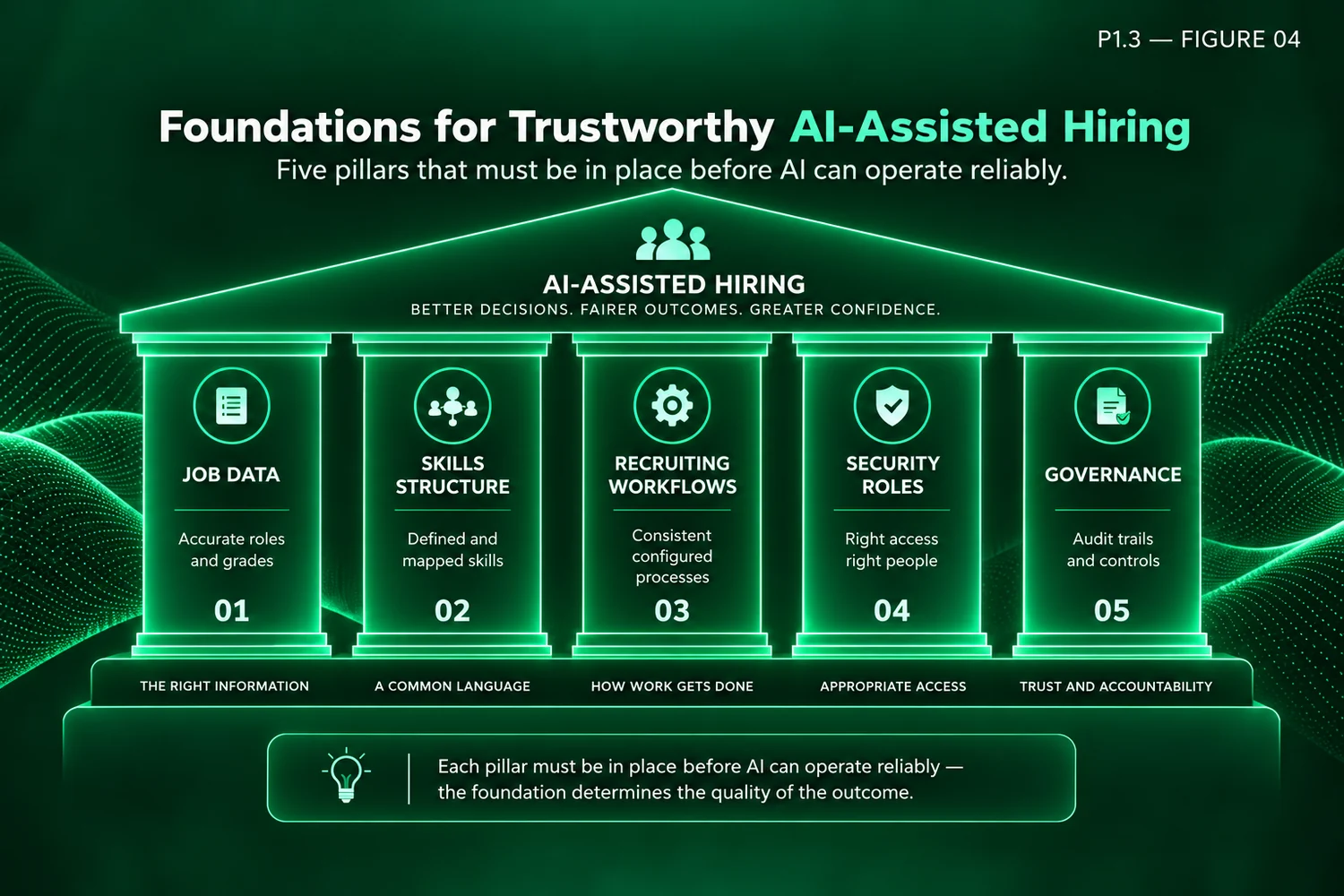
As with Core HR and Self-Service, the effectiveness of AI in recruiting depends on the quality of the foundations beneath it. Organisations that introduce AI-assisted capabilities without addressing these foundations often find that AI exposes inconsistency faster than it improves outcomes.
For AI-assisted recruiting to function reliably, several elements must be in place:
- Clean job and requisition data. AI matching relies on accurate and consistent job definitions. Poorly structured or duplicated requisitions reduce signal quality immediately.
- Consistent skills and competency usage. When skills are applied inconsistently across roles, AI cannot reliably identify alignment between candidates and requisitions.
- Standardised recruiting workflows. Clear stage definitions and consistent process design ensure AI signals and recommendations are interpreted consistently across recruiting teams.
- Clear recruiter security roles. Requisition ownership and recruiting team visibility must be correctly configured in Oracle before AI ratings are enabled. If they are not, Candidate Matching Ratings will surface scores for pipelines a recruiter has no authority to act on, creating confusion, potential data exposure, and the appearance of AI behaving unpredictably. Security is not a post-enablement concern in recruiting; it is a prerequisite.
- Governance and fairness controls. Candidate Matching Ratings are configurable. Administrators can weight Education, Experience, and Skills differently depending on the role type. Those weighting decisions must be deliberate, documented, and reviewed for fairness before ratings are shown to recruiters. An AI score that a recruiter cannot explain to a hiring manager or a candidate is a governance failure, not a system limitation.
With these foundations in place, AI-assisted recruiting becomes a design challenge, not a feature enablement exercise. In practice this means:
- Designing Redwood recruiting pages as decision surfaces, supporting how recruiters interpret and act on information.
- Reducing duplicate filters and manual sorting behaviours that undermine AI signals.
- Reinforcing through design and change management that AI supports prioritisation, not selection.
- Developing recruiter capability around signal interpretation and structured evaluation, rather than system navigation.
Together these foundations and design choices determine whether AI in Redwood recruiting becomes a practical decision aid or simply another layer of system complexity.
Swipe horizontally to inspect this figure.
Strategic Takeaway
Across Phase 1, covering HR Specialists, Employees and Managers, and now Recruiters, a consistent principle has emerged.
The mechanism differs by audience, but the underlying model remains consistent:
- AI reduces friction before execution begins
- Redwood supports structured execution, governance, and compliance
- Design determines whether that combination delivers value or introduces complexity
Across the three articles, this plays out differently for each role. For HR Specialists, AI helps identify the right transaction. For Employees and Managers, it helps initiate the right process. For Recruiters, it helps prioritise where attention should be applied first.
The diagram below brings this pattern together across all three groups.
Organisations that treat AI-assisted recruiting as a feature will see incremental efficiency gains. Organisations that redesign how recruiter attention is allocated will see a fundamentally different hiring experience, for recruiters, hiring managers, and candidates alike.
Closing Phase 1: The Pattern That Now Holds
Phase 1 has examined three distinct user groups, HR Specialists, Employees and Managers, and Recruiters, and in each case the same structural shift is visible.
Redwood simplifies how users interact with the system. AI reduces the effort required before action begins. The way these capabilities are designed determines whether they are adopted in practice.
What Phase 1 has also revealed is that none of this works reliably without strong foundations. Employment data, security architecture, process standardisation, skills data, and governance clarity are not prerequisites that can be deferred. They are the conditions that determine whether AI delivers value, or exposes fragmentation faster.
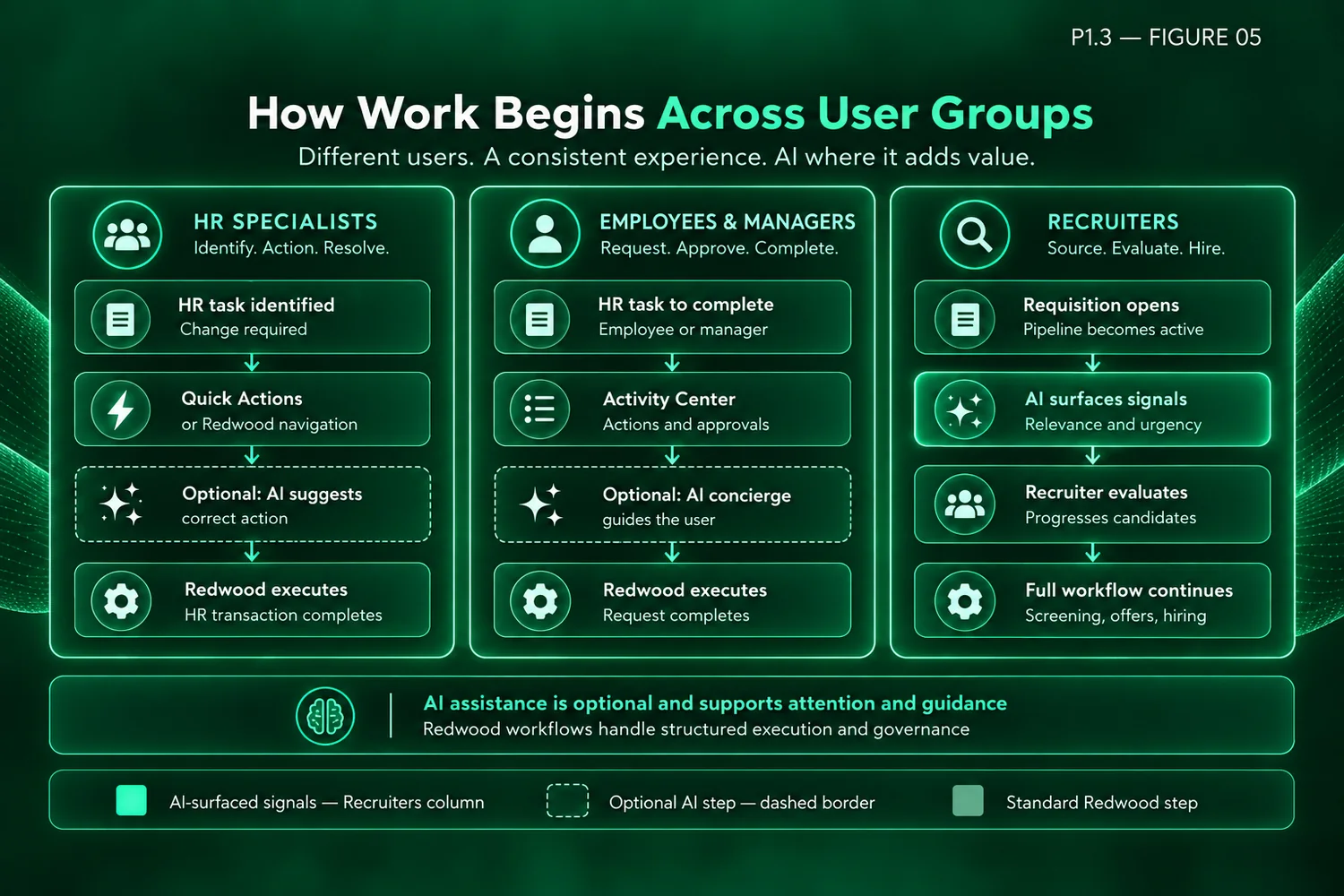
Swipe horizontally to inspect this figure.
AI Agents: Preparing Systems for Reliable Deployment
In the next article, AI Agents: Preparing Systems for Reliable Deployment, the series moves into Phase 2: AI Readiness.
Phase 1 established what Redwood and AI change in practice. Phase 2 examines what has to be ready before AI works reliably.
We’ll explore:
- Why data integrity is the single most critical factor in AI reliability, and where organisations most commonly underestimate its importance
- How security architecture shapes the quality and trustworthiness of AI‑guided interactions
- What process standardisation is required before AI agents can be introduced reliably
- And how to assess whether your Oracle HCM environment is genuinely ready for AI, before the gaps become visible in production
The question is not whether to invest in AI. The question is whether the conditions for reliable AI have been established.