Increasingly, the answer is that employees and managers no longer need to understand the system before they can use it.
In the first article in this series, I explored why Redwood adoption often stalls when organisations treat it as a UI upgrade rather than a behavioural shift.
This article examines what that shift means in practice, specifically how employees and line managers begin HR work when navigation is no longer the primary entry point.
Historically, enterprise HR systems expected users to understand system structure before taking action. Redwood and AI introduce a different model. Work increasingly begins with the action someone needs to perform rather than with menus or navigation paths. As a result, experiences must be designed to interpret user intent and guide them directly into the correct process.
In this article, I’ll explore:
- Why navigation no longer defines where HR work begins
- How Redwood reshapes the entry point into HR for employees and managers
- What AI-guided self-service looks like in practice, and where it adds real value
- How guided experiences reduce cognitive load while preserving governance and control
- What must be in place to ensure intent-led and AI-guided experiences work reliably at scale
Redefining Where Self-Service Updates Begin
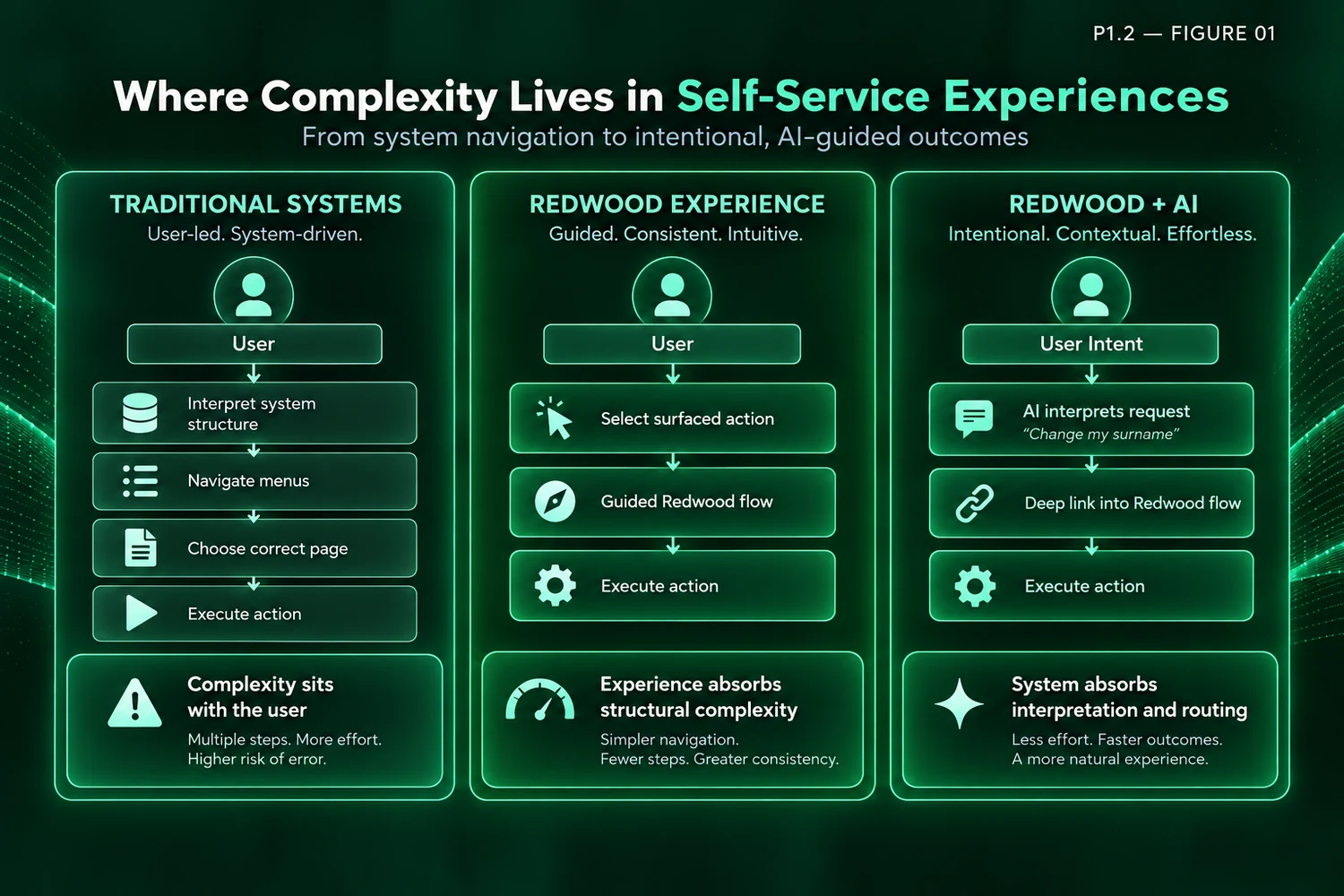
For decades, enterprise HR systems assumed that work began with navigation, requiring users to understand system structure before taking action. While HR specialists often developed this familiarity, employees and line managers interact too infrequently for navigation to become intuitive.
The challenge is rarely intent. Users usually know what they want to do. The challenge is translating that intent into the correct starting point.
Navigation does not disappear, but it no longer defines how work begins. When designed intentionally, Redwood activity centres and AI agents absorb structural complexity so users can focus on outcomes rather than mechanics.
Swipe horizontally to inspect this figure.
Why Redwood Changes the Entry Point
Oracle’s Redwood experience reflects a broader shift in how enterprise systems are designed to support everyday users. Rather than expecting employees and managers to understand system structure, Redwood introduces experience layers that help users begin work more naturally and with greater confidence.
Several Redwood capabilities contribute to this shift, including:
- Global search
- My Activity Center
- Team Activity Center
- Guided Redwood flows
- Contextual quick actions
- AI-assisted interaction
Together, these elements reduce reliance on traditional navigation by surfacing work that is relevant, timely, and role-appropriate.
My Activity Center and Team Activity Center apply this intent-led model to different roles. Employees see a consolidated view of personal tasks and requests, while managers see prioritised team-related activities such as approvals, performance tasks, and employment changes.
These hubs do not replace transactional pages. Instead, they act as initiation layers, guiding users directly into the appropriate Redwood flow once an action is selected.
In this model, employees and managers focus on what they need to do, while the system handles where the work begins.
Supporting Manager Confidence When Navigation Is No Longer Required
For line managers, the shift away from navigation can initially feel unfamiliar when intent-led entry points are not clearly designed. Managers rarely approach HR systems from a structural perspective. Their focus is the outcome, changing a location, ending employment, promoting someone, or moving a team member. When the system does not clearly surface these actions, hesitation increases.
In these situations, managers may delay tasks or escalate work they are technically able to complete, increasing reliance on HR and slowing routine decisions.
Organisations that handle this transition successfully treat manager entry as a design challenge rather than a training issue. Recurring actions are surfaced through Team Activity Center and launched through guided Redwood journeys or stable deep links that lead directly to the correct process.
When these elements are aligned, the experience changes. Instead of interpreting menus or navigation paths, managers start with the action they need to take, and the system guides them into the correct process.
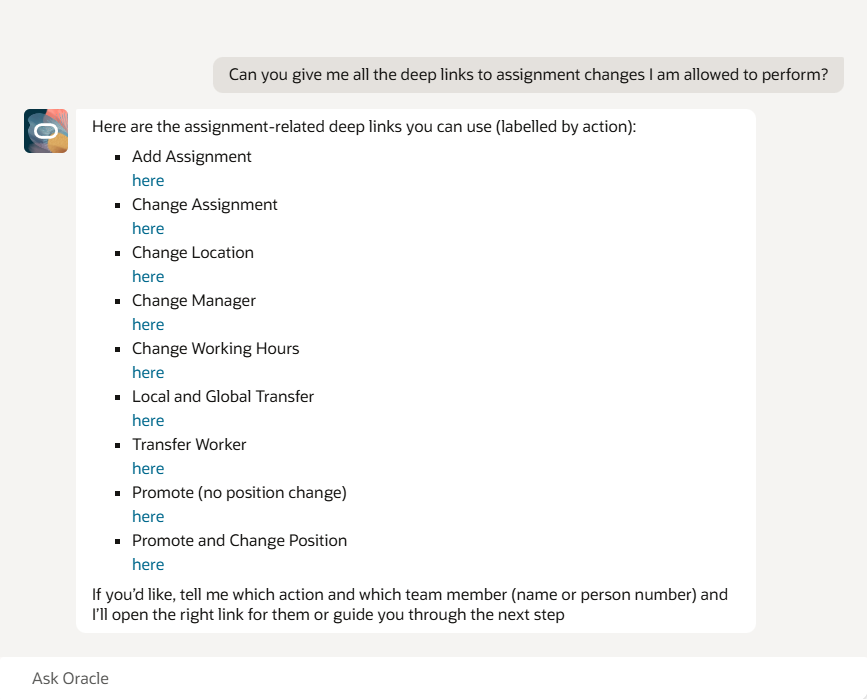
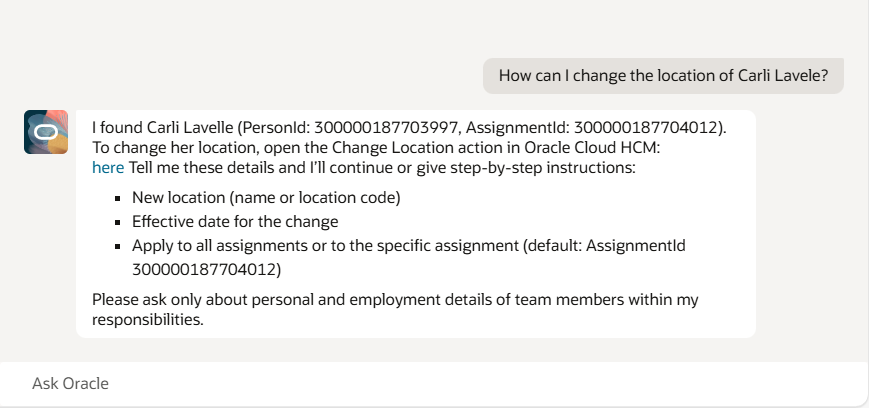
Here, the AI agent surfaces only assignment‑related actions the manager is authorised to perform, presenting a curated list of valid actions linked directly to the correct Redwood flows:
Swipe horizontally to inspect this figure.
Here, the AI agent helps the manager choose the correct process by distinguishing between similar actions:
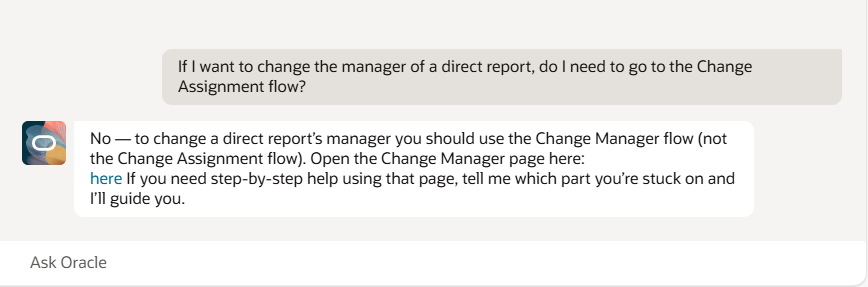
Swipe horizontally to inspect this figure.
AI interprets the request and deep links the user directly into the correct Redwood flow with context already established.
Concierge AI Agents in Self-Service
Concierge AI agents support task based interaction by helping employees and managers begin the right task without needing to understand system structure. They reduce uncertainty at the point work begins by:
- Interpreting natural language to identify underlying intent
- Presenting relevant actions based on role and permissions
- Routing users directly into the correct Redwood flow via deep links
- Clarifying which process should be used when multiple options exist
- Providing contextual guidance once the flow is launched
Concierge Agents in Practice
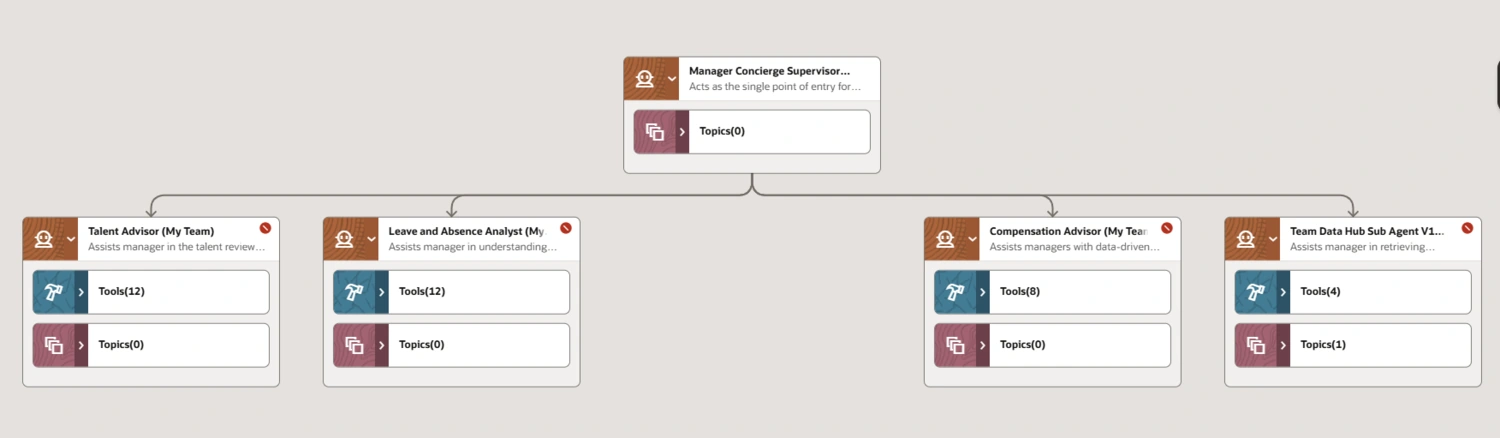
Employee Concierge and Manager Concierge agents provide conversational entry points aligned to the actions each role is authorised to perform. While the interaction pattern is consistent, understanding the request and guiding users into the correct Redwood flow, the scope of available actions differs by role.
Employee Concierge focuses on personal self-service tasks, while Manager Concierge supports team-related actions such as approvals, assignment changes, and performance activities.
In both cases, AI acts as a guidance layer at the start of the interaction, helping users start the right task while the underlying Redwood processes handle validation, governance, and completion.
Manager Concierge
Swipe horizontally to inspect this figure.
Managers typically know the outcome they want to achieve, promote an employee, approve a request, or review team performance, but may not always remember where those actions sit within the system. Manager Concierge helps translate these outcomes into the correct Redwood process.
For example, a manager might type “Promote Sarah.” The agent recognises the intent, confirms the employee context, and launches the Promote Redwood flow with the correct record already selected.
A manager might also ask “Who hasn’t completed performance reviews?” The agent surfaces the relevant team information and directs the manager to the appropriate performance pages where action can be taken.
Similarly, when a manager types “Approve John’s leave,” the agent identifies the pending approval and provides a direct link to the approval task, avoiding the need to navigate approval worklists or menus.
In each case, the agent does not replace the underlying process. Instead, it helps managers start in the right place, allowing Redwood flows to handle validation, governance, and completion of the action.
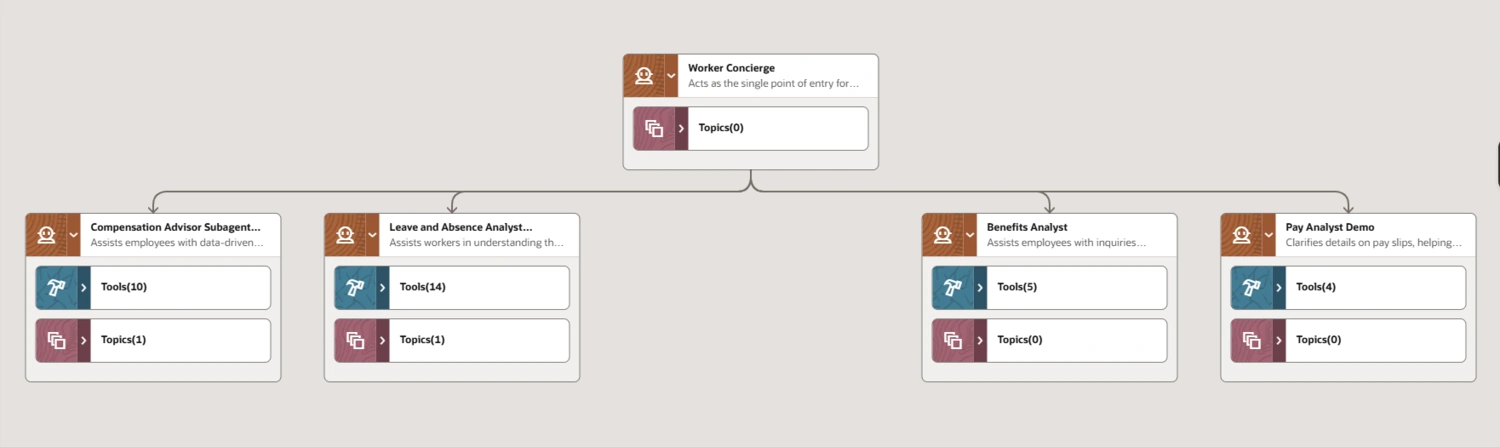
Employee Concierge
Swipe horizontally to inspect this figure.
Employee Concierge applies the same intent-led pattern to personal self-service interactions.
An employee might type “Update my address.” The agent recognises the request and launches the Change Address Redwood flow with the employee’s context already loaded.
The same approach applies to common tasks such as checking absence balances, viewing personal information, or initiating benefits-related processes. Instead of locating the correct page through menus, the employee expresses intent and is guided directly into the relevant Redwood flow.
In this model, employees begin with what they need to do, while the system handles where the process begins.
From Intent to Guided Execution
Starting work in the right place is only part of the experience. Once users enter a Redwood process, the interaction must still support confident and informed decision-making, particularly when actions carry policy, compliance, or downstream implications.
Many HR interactions involve interpretation rather than simple execution. Employees and managers are often acting under time pressure, navigating policy requirements, or making decisions that affect others. In these situations, clarity matters more than speed.
Redwood guided journeys are designed to support this by shaping the experience around decision support rather than navigation. Steps are sequenced logically, constraints are surfaced early, and decisions are framed within the correct context. Instead of requiring users to interpret policy or process structure themselves, the system provides guidance at the point decisions are made.
Governance, validation, and compliance remain embedded within the flow, ensuring that actions remain controlled and auditable while still allowing users to proceed with confidence.
When combined with AI-guided entry points, this model creates a complete interaction cycle:
Intent → AI guidance → Guided journey → Action
Users no longer need to determine where work begins or how a process should unfold. The system interprets intent, initiates the correct experience, and supports execution through a structured and compliant path.
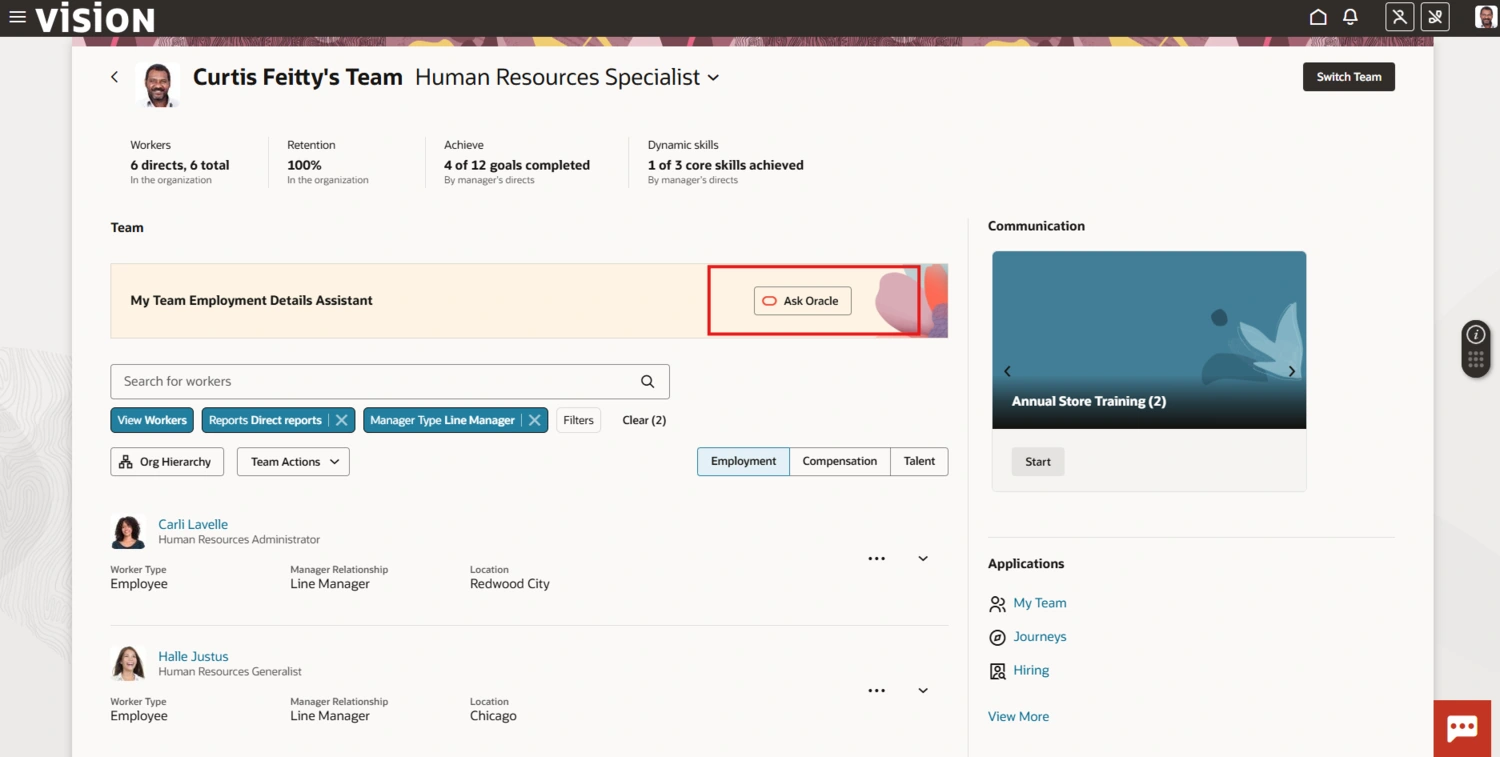
AI‑Guided Entry with Deep Links
When intent is expressed conversationally, AI‑guided entry clarifies scope, confirms context, and routes the user via a deep link into the appropriate Redwood flow, ensuring they land in the right place, with the right permissions, and without needing to interpret next steps.
Swipe horizontally to inspect this figure.
Swipe horizontally to inspect this figure.
Reducing Cognitive Load Without Reducing Control
A key benefit of AI‑guided interaction is the reduction of cognitive load. Employees and managers can focus on outcomes rather than understanding system structure. Intent is expressed, context is established, and execution is guided within the correct Redwood flow.
In practice, reducing hesitation does not require more training. It requires clearer entry design. Organisations see the strongest results when they deliberately design how work begins: treating Activity Center and Team Activity Center as initiation layers, surfacing common actions through guided Redwood journeys, removing low‑value or duplicate menu entries, and using stable deep links to land users directly in the correct flow.
Where used, AI adds value by clarifying intent and confirming the correct process, but it is not required for the model to work.
When these elements are aligned, Redwood absorbs structural complexity. Employees and managers can start with what they need to do, trust they are in the right place, and proceed with confidence, with governance embedded in the flow.
What Changes When Navigation Is No Longer the Starting Point
When intent‑led interaction is designed effectively, the most noticeable change is confidence. Tasks are initiated more quickly, fewer transactions are abandoned, and dependency on HR for navigation support decreases. Employees and managers act knowing that validation and governance are embedded within the flow.
As a result, organisations reduce training focused on system navigation and instead reinforce responsibility and decision‑making. The platform handles structural complexity; users focus on the outcome, and that is where Redwood and AI‑guided interaction begin to change how everyday HR work actually happens.
Ensuring AI Adoption Runs Smoothly
For AI-guided experiences to work reliably, design discipline matters more than individual features. Organisations seeing the strongest outcomes typically ensure that:
- My Activity Center and Team Activity Center act as initiation layers, not operational destinations
- Guided Redwood flows sequence decisions clearly and surface constraints early
- Deep links route users into stable, well-governed Redwood processes
- Security roles and data visibility are clearly structured
- Validation and compliance remain embedded within the flow
AI does not replace this foundation. It reinforces it. Strong design increases confidence; weak design is exposed more quickly.
Implementation Considerations
Designing AI-guided interaction requires more than enabling new features. Organisations must deliberately shape how users begin work so that guidance reinforces the intended experience rather than introducing new complexity.
Avoiding AI as a Faster Form of Search
Without careful design, AI risks becoming little more than a faster way to locate pages. Users may reach the correct transaction more quickly, but they are still required to interpret context, confirm they are in the right place, and decide how to proceed. In these situations, the interaction model has not fundamentally changed. Navigation has simply been accelerated.
Well-designed AI guidance works differently. Instead of acting as a search shortcut, AI interprets the action being requested and directs users into the correct Redwood flow with context already established. The goal is not to help users find pages faster, but to help them begin the right process with clarity and confidence.
Foundations for Reliable AI‑Guided Experiences
For AI guidance to operate reliably at scale, several foundations must be in place:
- Data readiness. AI guidance depends on clean, consistent data. Fragmented employment, assignment, or organisational structures quickly undermine trust.
- Security clarity. Agents must respect role-based access and organisational boundaries, surfacing only actions users are authorised to perform.
- Stable Redwood flows. Deep links and entry points must align to stable, well-governed Redwood processes so users are routed consistently into the correct experience.
- Clear process ownership. AI cannot compensate for unclear ownership or governance. Processes and escalation paths must be defined before intelligent guidance is introduced.
Design Implications for Organisations
Organisations implementing Redwood should reconsider how employees and managers begin HR work. In practice, this means:
- prioritising Activity Center as the primary entry point for recurring tasks
- reducing duplicate navigation entry points that create confusion
- using stable deep links for high-frequency actions
- designing Redwood flows that minimise interpretation once a transaction begins
- introducing AI guidance only where it clarifies intent or reduces decision friction
Strategic Takeaway
Recent Oracle HCM releases continue expanding AI-guided capabilities within Redwood, including concierge-style assistance and AI-supported workflows. While these features will continue to evolve, they reinforce a clear direction: interactions increasingly begin with user intent and are then routed into structured Redwood flows where work is executed.
In practice, this interaction model is not a single capability, but the result of multiple Redwood experience layers working together. When designed intentionally, employees and managers can start with what they need to do, without needing to understand system structure, while governance and validation remain embedded within the flow.
This is how confidence is built at scale: not by removing control, but by designing experiences that make the right action the easy one.
Organisations that treat AI as a feature will see incremental improvements.
Organisations that redesign how work begins will see a fundamentally different employee experience.
Oracle HCM Beyond Traditional Recruiting: AI-Assisted Hiring in Redwood
In the next article, Oracle HCM Beyond Traditional Recruiting: AI-Assisted Hiring in Redwood, the focus shifts to how recruiters interact with Oracle Recruiting Cloud when AI begins supporting earlier stages of the hiring process.
The article examines how AI-assisted capabilities help recruiters identify and prioritise candidates more effectively, reducing the manual effort involved in reviewing large applicant pools while improving the speed and confidence of hiring decisions.
We’ll explore:
- How AI can surface the most relevant candidates earlier in the recruitment process
- How intelligent recommendations support confident prioritisation of applicants
- How Redwood-based experiences reshape how recruiters interact with candidate pipelines
- And how AI can assist recruiter decision-making while maintaining the structured hiring workflows that ensure governance and fairness
The shift is not about replacing recruiter judgement.
It is about helping recruiters reach the right candidates faster and with greater confidence.
Oracle AI Agents Discussed in This Article