


Artificial intelligence is rapidly becoming embedded within enterprise systems, including Oracle HCM. Yet many organisations discover that introducing AI is not primarily a technology challenge. It is a systems readiness challenge.
When data structures are inconsistent, workflows vary, or security models are poorly aligned, AI does not simplify operations. It exposes those weaknesses faster.
AI Assistants vs AI Agents in Enterprise Systems
AI operates in different forms within enterprise systems.
AI assistants, typically powered by generative AI and large language models (LLMs), support users within a specific interaction, answering questions, generating content, or providing guidance.
AI agents operate at a different level. They function within enterprise workflows, interpreting structured data, understanding process context, and surfacing the next recommended steps with deep links that guide users through the transaction.
This distinction matters because the level of system readiness increases as AI moves from assisting users to participating in how work is executed.
As Oracle continues to expand agentic capabilities within Fusion Applications, this distinction becomes even more important. Future agentic workflows will not only guide users but autonomously progress transactions within defined guardrails, making system readiness a prerequisite for reliable, safe execution.
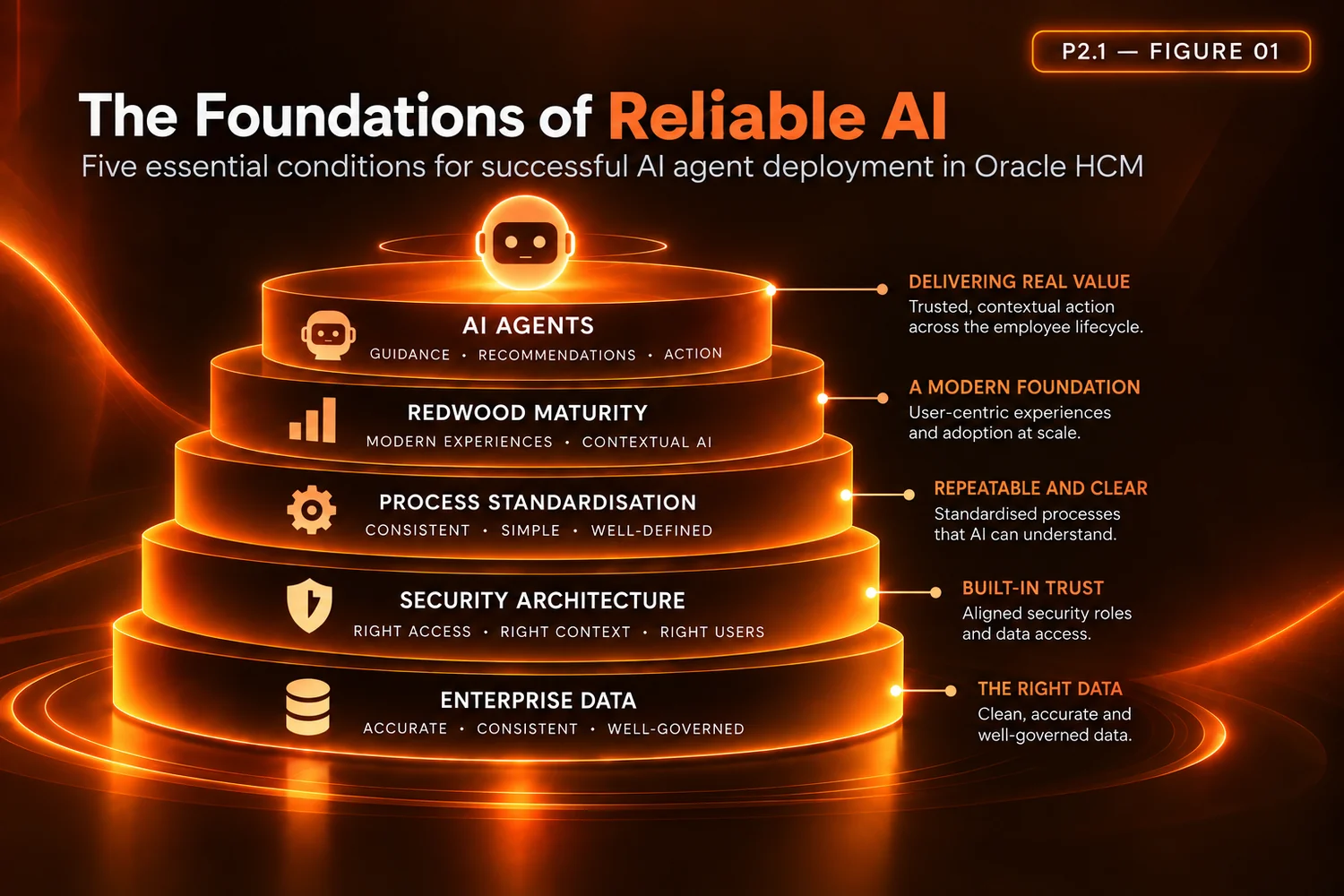
Why AI Reliability Begins Long Before Deployment
Artificial intelligence in enterprise systems is often discussed as a deployment challenge, selecting models, configuring agents, and integrating AI into workflows. In practice, reliability is determined much earlier.
When AI interacts with inconsistent data, fragmented workflows, or poorly aligned security models, its outputs become unpredictable.
This is particularly relevant within Oracle HCM, where AI capabilities are designed to operate within the structured architecture of Redwood experiences and enterprise data models. When these foundations are stable, AI can guide decisions and support workflow execution. When they are not, outputs become inconsistent and difficult to trust.
In other words, AI reliability is not primarily a question of algorithms. It is determined by the systems, processes, and data structures the technology depends on.
Swipe horizontally to inspect this figure.
Data Integrity: The First Condition for Reliable AI
Reliable AI begins with reliable data.
AI‑assisted decisions depend on consistent job structures, accurate person records, well‑maintained skills data, and clean transactional history. When these are inconsistent, AI interprets the noise as real patterns, producing unreliable or misleading insights.
Data issues often accumulate slowly, variations in job definitions across business units, skills captured differently in requisitions, or duplicate person records introduced through integrations. Individually small, these inconsistencies distort the signals AI relies on.
When AI‑assisted candidate matching is enabled, inconsistent job definitions across regions can cause the same role to be described differently. AI then ranks candidates inconsistently: strong candidates may appear less suitable simply because role definitions vary, not because of flaws in the model. The root issue is lack of standardisation, not AI performance.
Targeted data cleansing, removing duplicate records, aligning job structures, and standardising skills data, is essential before enabling AI. AI does not correct poor data; it exposes it faster.
Many organisations only discover these issues when AI features go live. In recruiting, inconsistent job definitions or poorly structured skills fields can immediately result in weak or misleading candidate‑matching signals.
Before enabling AI-assisted capabilities, organisations should examine:
- Consistency of job and requisition definitions
- Duplication within employee or candidate records
- Standardisation of skills data across business units
- Whether targeted data cleansing is required before enabling AI capabilities
When data is structured consistently, AI‑generated signals become more reliable and easier for users to trust.
Security Architecture and AI Context
AI systems must operate within the same security boundaries that govern human users.
In Oracle HCM, role‑based security determines which employees, transactions, and data elements a user can access, and AI‑assisted features inherit this exact context.
When security roles are inconsistent or misaligned across the organisation, AI guidance becomes unpredictable, not because the model is incorrect, but because different users have different visibility into the data the AI depends on. This erodes trust in AI‑supported decisions. AI doesn’t introduce a new security model; it simply amplifies the importance of the existing one.
If two HR specialists initiate the same assignment change, one may receive detailed guidance on approval steps while the other sees limited or no prompts. The AI is behaving consistently with each person’s permissions; the inconsistency stems from misaligned access, not model failure.
This issue often becomes visible when HR specialists performing similar transactions receive inconsistent AI-assisted guidance.
Before enabling AI-assisted capabilities, organisations should review:
- Whether security roles clearly reflect HR process ownership
- Whether similar roles across business units provide consistent access to transactions
- Whether AI-enabled workflows inherit the correct permissions for the user initiating the action
When security roles are clearly defined and consistently applied, AI behaves predictably, data access remains controlled, and organisations maintain confidence in AI‑assisted decisions.
Process Standardisation
AI agents rely on predictable processes.
When workflows follow consistent patterns, AI can interpret context, identify decision points, and surface recommendations at the correct stage. When processes vary widely between business units or teams, the signals the AI depends on become fragmented.
In HR operations, this variability often appears in lifecycle transactions such as assignment changes, promotions, approvals, and onboarding. Some organisations use clearly defined stages and approval steps, while others allow significant variation. For human users this creates operational complexity; for AI systems it creates ambiguity, making guidance less reliable. Standardised workflows provide the structure AI needs to understand where a transaction sits and what normally follows.
Consider a promotion process where departments use different approval stages. AI may surface recommendations early in one workflow but much later in another. The inconsistency is not caused by the AI itself, but by variability in how the process is configured. This fragmentation causes confusion for users and undermines trust in AI guidance.
This issue typically becomes visible during testing or early rollout: AI guidance appears correctly in one business unit but fails to surface, or appears at the wrong stage, in another. The transaction is identical; the process configuration is not.
Organisations preparing for AI should review:
- Lifecycle transactions such as assignment changes or promotions
- Approval patterns across similar processes
- Stage definitions in workflows such as recruiting or onboarding
When workflows follow consistent patterns, AI agents can interpret context more reliably and provide guidance at the correct stage of a process.
Redwood Maturity as an AI Prerequisite
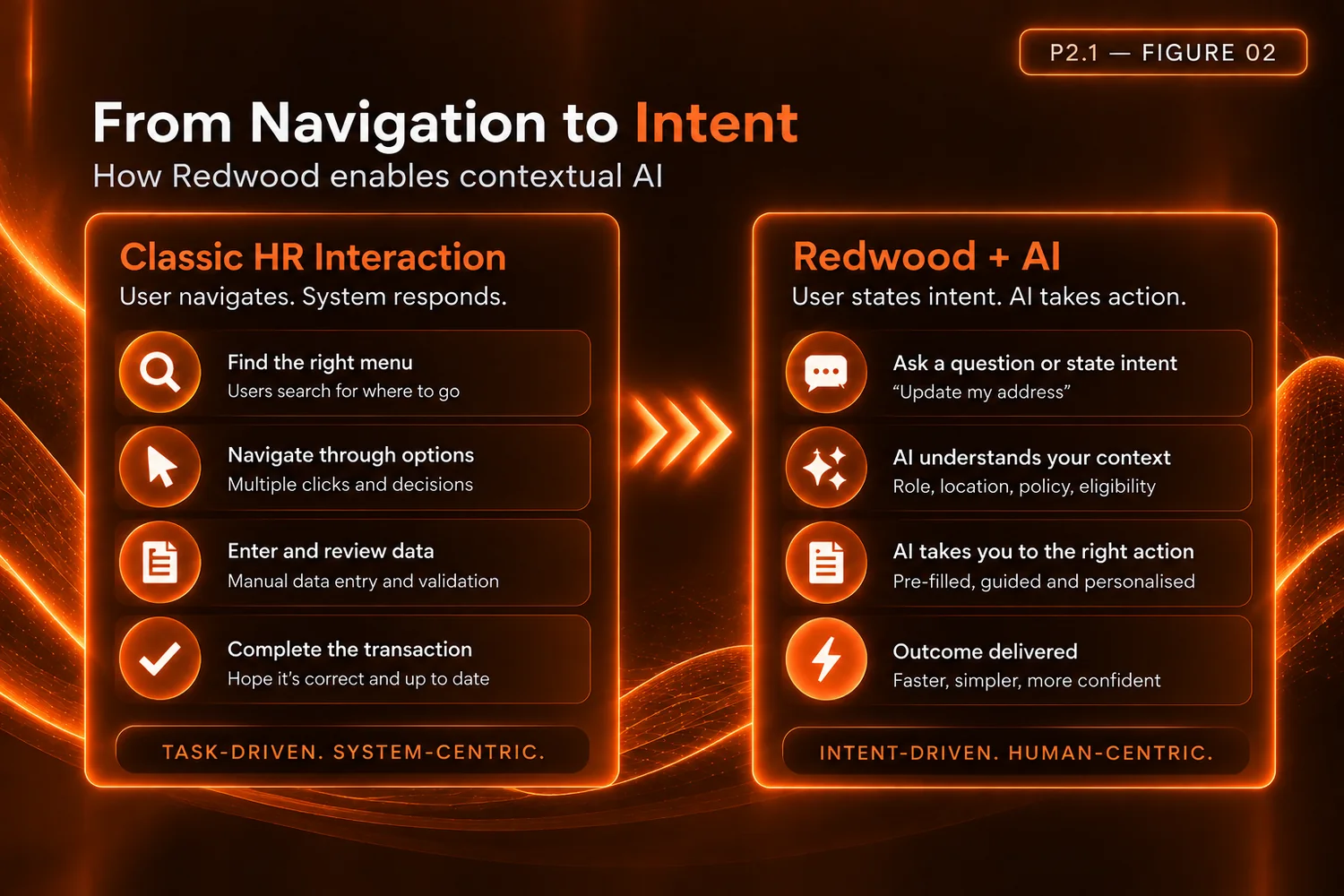
Oracle’s AI capabilities are designed to operate within Redwood user experiences.
Redwood provides interaction patterns that supply the contextual signals AI relies on, such as workflow state awareness and task‑based interaction surfaces. When organisations work within Redwood, these signals are consistently available. When activity still occurs on Classic pages or fragmented navigation paths, those signals become inconsistent.
The result is not that AI cannot function, but that its effectiveness becomes limited. AI guidance may appear in some workflows but not others, depending on whether the user is in Redwood or Classic. Redwood adoption is often viewed as a UI change, but it is also part of the architectural foundation that enables AI to interpret workflows reliably.
Swipe horizontally to inspect this figure.
An HR specialist may receive contextual AI guidance when initiating a transaction in a Redwood page, but see no guidance when completing related steps in a Classic interface. The inconsistency is not caused by the AI capability itself, but by the different interaction models and missing contextual signals available only in Redwood.
Organisations enabling AI capabilities while significant HR activity still relies on Classic pages frequently see fragmented experiences, AI guidance appearing in some steps but disappearing or surfacing incorrectly in others, depending on where the interaction occurs.
Before introducing AI capabilities, assess:
- Which HR processes already operate fully within Redwood
- Where Classic pages are still used for core transactions
- Whether users rely on deep links or guided navigation within Redwood
When core HR processes are executed within Redwood experiences, AI can provide more consistent contextual guidance across workflows.
Architectural Readiness for AI Agents
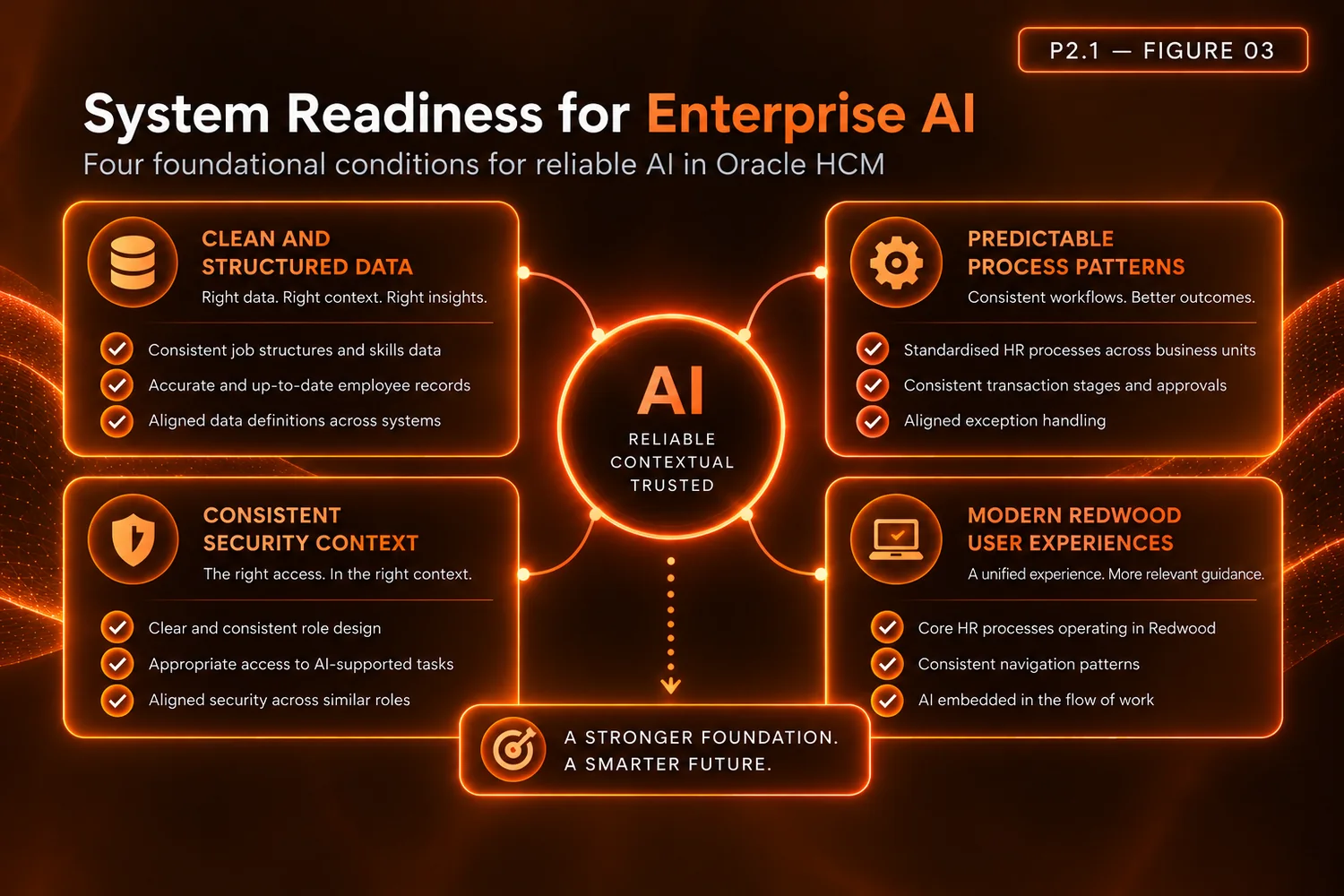
Reliable AI does not depend on a single technical component. It requires the alignment of several foundational elements:
- Clean and structured data
- Predictable workflow patterns
- Consistent security context
- Modern interaction surfaces such as Redwood experiences
When these foundations are in place, AI agents can interpret context, guide decisions, and support users reliably. When they are not, AI outputs become inconsistent and difficult to trust. Preparing systems for AI therefore requires organisations to look beyond the technology itself and examine the architecture supporting it.
Swipe horizontally to inspect this figure.
Additional System Considerations
Beyond core data, security, process, and UI alignment, organisations should also assess broader architectural behaviours:
- Data consistency across sources conflicting definitions across systems distort AI signals.
- Data timeliness delayed updates cause AI to rely on outdated information.
- Transaction completeness incomplete processes skew AI patterns.
- Exception‑handling consistency inconsistent edge‑case behaviours reduce reliability.
These factors are less visible but critical for ensuring AI performs reliably in practice.
Implementation Considerations
To prepare for AI within Oracle HCM, organisations should translate readiness principles into targeted action:
- Conduct data quality reviews to identify inconsistencies in job structures, skills data, and employee records.
- Assess Redwood adoption maturity, prioritising migration of core workflows to Redwood so AI can surface contextual guidance consistently.
- Review workflow alignment across business units to ensure transactions follow predictable stages.
- Validate security role design so users initiating AI‑supported tasks have consistent, appropriate access.
These steps may appear operational, but they determine whether AI guidance can be trusted once deployed.
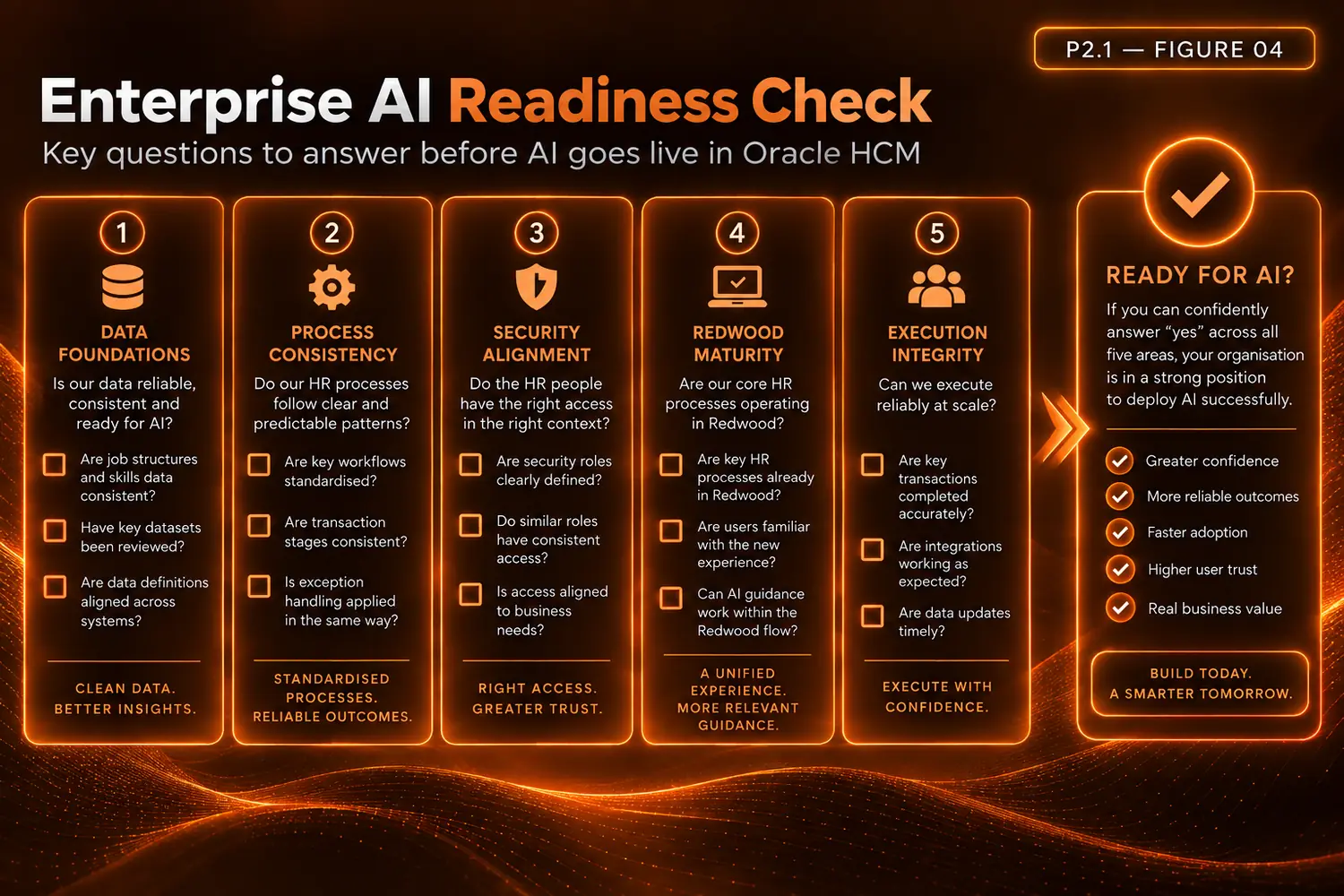
Quick System Readiness Check
Organisations preparing for AI adoption should be able to answer the following questions:
Data Foundations
- Are job structures, skills data, and employee records consistent across the organisation?
- Have key datasets been reviewed for duplication or inconsistencies requiring cleansing?
- Are data definitions consistent across integrated systems?
- Are key datasets updated in a timely manner so AI does not rely on outdated information?
Process Consistency
- Are HR workflows, especially lifecycle transactions, standardised across business units?
- Are exception‑handling steps applied consistently?
Security Alignment
- Do security roles clearly define who can access each transaction?
- Do similar roles across the organisation provide consistent access?
Redwood Maturity
- Are core HR processes already operating within Redwood experiences?
- Are users relying on consistent navigation patterns rather than Classic pages or deep-link workarounds?
Execution Integrity
- Are key transactions routinely completed end‑to‑end without gaps or workarounds that distort AI patterns?
If the answer to these questions is unclear, system readiness should be addressed before AI capabilities are introduced.
Swipe horizontally to inspect this figure.
AI agents are often discussed as a new layer of capability within enterprise systems, but their effectiveness depends on something more fundamental. Reliable AI begins with the systems, data, and processes that support it. When these foundations are strong, AI can guide decisions and execute workflows effectively. When they are fragmented, AI exposes inconsistencies faster than it resolves them.
System readiness is not a technical detail. It is the condition that determines whether AI delivers meaningful value.
AI Agents: Identifying Where Intelligence Creates Real Value
In the next article, AI Agents: Identifying Where Intelligence Creates Real Value, the focus shifts to how organisations determine where AI can genuinely improve how HR work gets done.
The article examines how enterprise teams can identify the processes where AI delivers meaningful operational value, distinguishing between activities that benefit from intelligent guidance and those that remain better suited to structured automation or human judgement.
We’ll explore:
- How to recognise HR processes where AI-assisted decision support creates the greatest impact
- Why high-volume, decision-heavy workflows are often the strongest candidates for AI
- How organisations can prioritise use cases before introducing AI agents into production environments
- And how to apply a simple framework for identifying where intelligence meaningfully improves enterprise HR operations
The question is not simply where AI can be used.
It is where AI should be used to improve how work actually gets done.