The previous article established what must be in place before Oracle HCM Cloud AI can operate reliably: clean data, consistent security, standardised processes, and Redwood maturity. Those foundations determine whether AI guidance can be trusted once it is live.
This article addresses the next question: where do you actually apply it? Oracle HCM Cloud AI now spans Core HR, Recruiting, Talent Management, Journeys, and Workforce Management, and the catalogue grows every quarter. The risk for most organisations is not a shortage of options. It is applying AI to processes where the conditions are not right, seeing weak results, and losing the confidence to invest further.
The right approach is selective and evidence-based. Oracle HCM Cloud AI delivers the most value where human attention is genuinely the limiting factor: where volume creates real bottlenecks, where decisions require weighing multiple variables simultaneously, and where the cost of inconsistency or delay accumulates across large populations. The framework below gives you a consistent way to identify where that is in your organisation.
A Framework for Identifying High-Value AI Use Cases
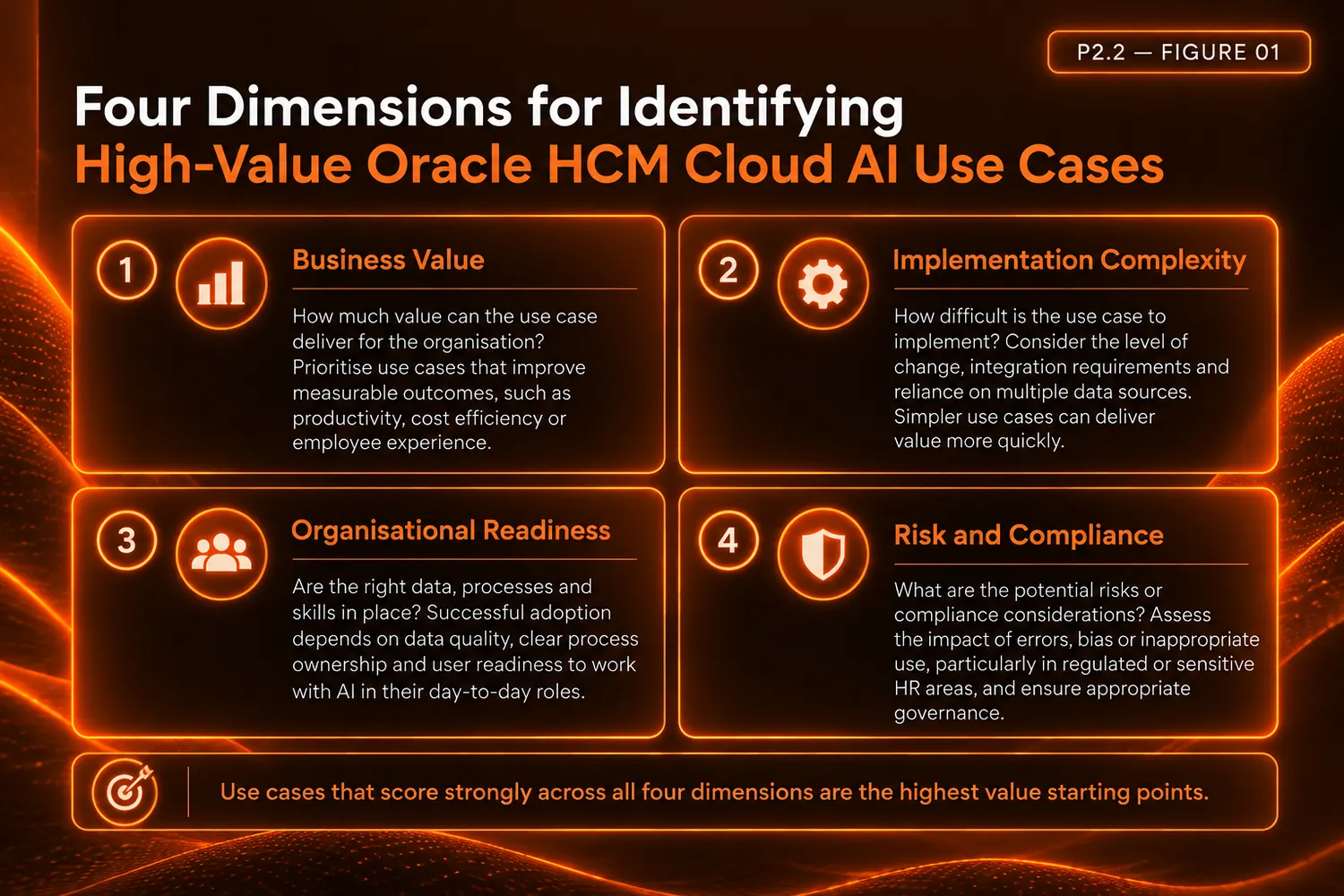
Before enabling any Oracle HCM Cloud AI capability, assess each candidate process against four dimensions. Processes that score strongly across three or more are your highest-confidence starting points, and those will differ by organisation.
Swipe horizontally to inspect this figure.
The framework is not a checklist that points to one universal answer. Recruiting and goal management are commonly cited examples because both score strongly across all four dimensions for most organisations. But a high-volume onboarding process with complex downstream compliance steps scores just as well. So does a workforce scheduling process where delays carry real operational cost. The framework works because it forces a conversation about process conditions before reaching for a feature.
Three Practical Lenses to Sharpen Your Shortlist
The four-dimension framework gives you a structured way to score process conditions. Three additional lenses help you validate and prioritise that shortlist before committing to an enablement sequence.
Map process conditions against your organisation's known pain points
The framework assesses whether a process is structurally suited to AI. Your organisation's pain points tell you where the demand for improvement already exists. Where both point to the same process, strong framework conditions and recognised operational friction, you have your highest-confidence starting point and your most straightforward internal conversation. A process that scores well on the four dimensions but generates no complaints is a weaker candidate than one where HR teams are already vocal about the problem it would solve.
A practical way to surface this is to map your candidate processes against what HR specialists, managers, and recruiters are already escalating or working around. Friction that shows up consistently in support tickets, approval delays, or manual workarounds is a reliable signal. It also means the people who will use the AI guidance are already motivated to engage with it.
Start where you already have a baseline
The article returns to this point in Implementation Considerations, but it is worth applying it at the selection stage too. Processes where you already track a meaningful metric, time to hire, goal completion rates at cycle open, volume of manual Journey follow-ups, let you demonstrate AI's impact from day one without building a measurement capability alongside the deployment. If you have to create the measurement infrastructure at the same time as enabling the AI, your evidence timeline doubles and the internal case becomes harder to make.
When two processes score similarly against the four dimensions and both address recognised pain points, the one where baseline data already exists should move up the sequence.
Do a data quality spot-check in the candidate domain before scoring
Article 4 in this series covered data integrity as a foundation for AI reliability. A more specific step at the selection stage is to check whether the data AI would actually use in each candidate domain is clean enough to produce trustworthy signals. AI candidate matching is only as good as your skills data consistency. Goals AI is only as good as the quality and completeness of goal records. Journey automation is only as good as the consistency of your Journey task configuration.
A domain that scores strongly on the four dimensions but has known data quality gaps in the specific fields the AI depends on should be treated as a conditional candidate, ready to enable once those gaps are resolved, not before. This check takes the readiness assessment from Article 4 and applies it at the level of each candidate process rather than the whole platform.
The Failure Mode: Starting in the Wrong Place
Organisations that skip this assessment and enable AI broadly, or default to whatever Oracle has most prominently announced, typically encounter the same pattern. A process runs infrequently, involves a single decision point, affects a small population, and produces no measurable baseline. The AI guidance surfaces. Nobody engages with it. The evidence base is thin. Investment stalls.
A poor early experience is also harder to reverse than most organisations expect. If managers or HR specialists encounter AI guidance that feels irrelevant or inconsistent, because the underlying process conditions were not right, they disengage. That disengagement carries across to other AI deployments on the platform. Starting where the conditions are right is not a preference. It is the decision that determines whether AI builds credibility or loses it.
Where Oracle AI Has the Strongest Process Fit
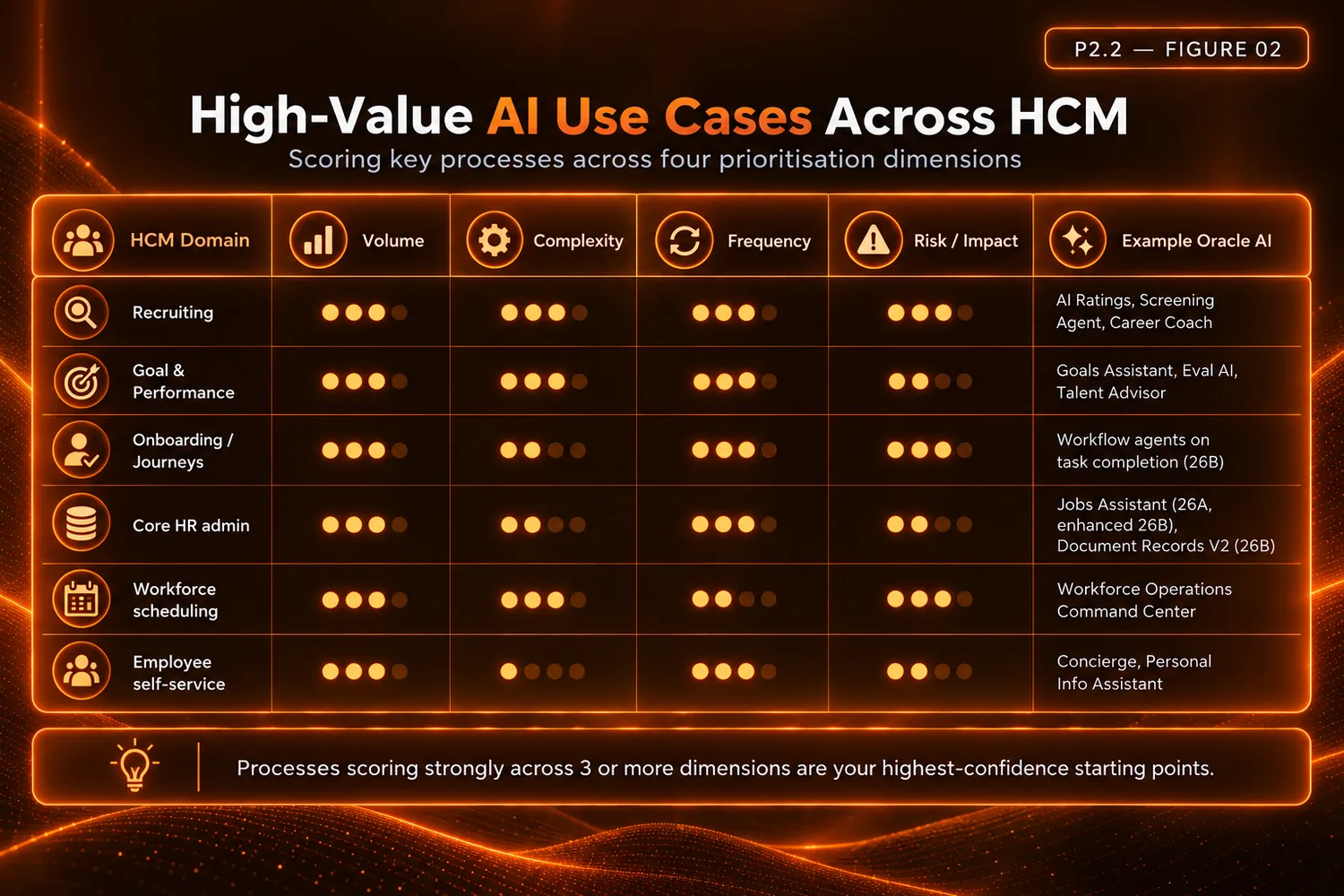
As of Release 26B, Oracle HCM Cloud AI is live and substantive across multiple domains. The table below maps each domain against the four framework dimensions, giving a starting picture of where the strongest fit tends to be, before organisations apply their own context.
Swipe horizontally to inspect this figure.
This is a starting map, not a prescription. The right process to begin with is the one where your data is clean, your workflow is standardised, and you can measure the difference before and after. For many organisations that will be Recruiting or Talent. For others it will be onboarding journeys or Core HR administration, particularly as Oracle's 26B agents in those areas have now reached the maturity needed for production use.
What Has Changed in 26B
Release 26B is significant not because it adds AI to areas that had none, but because it substantially matures capability in areas that previously felt early-stage, particularly Core HR and Journeys.
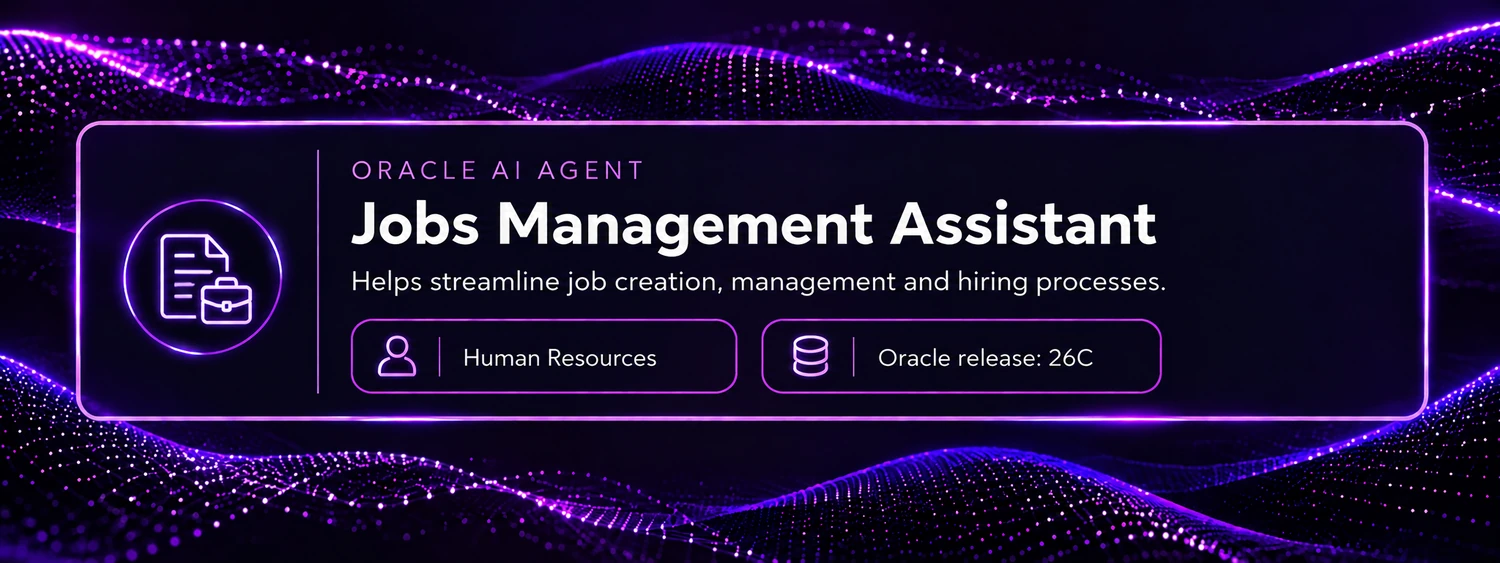
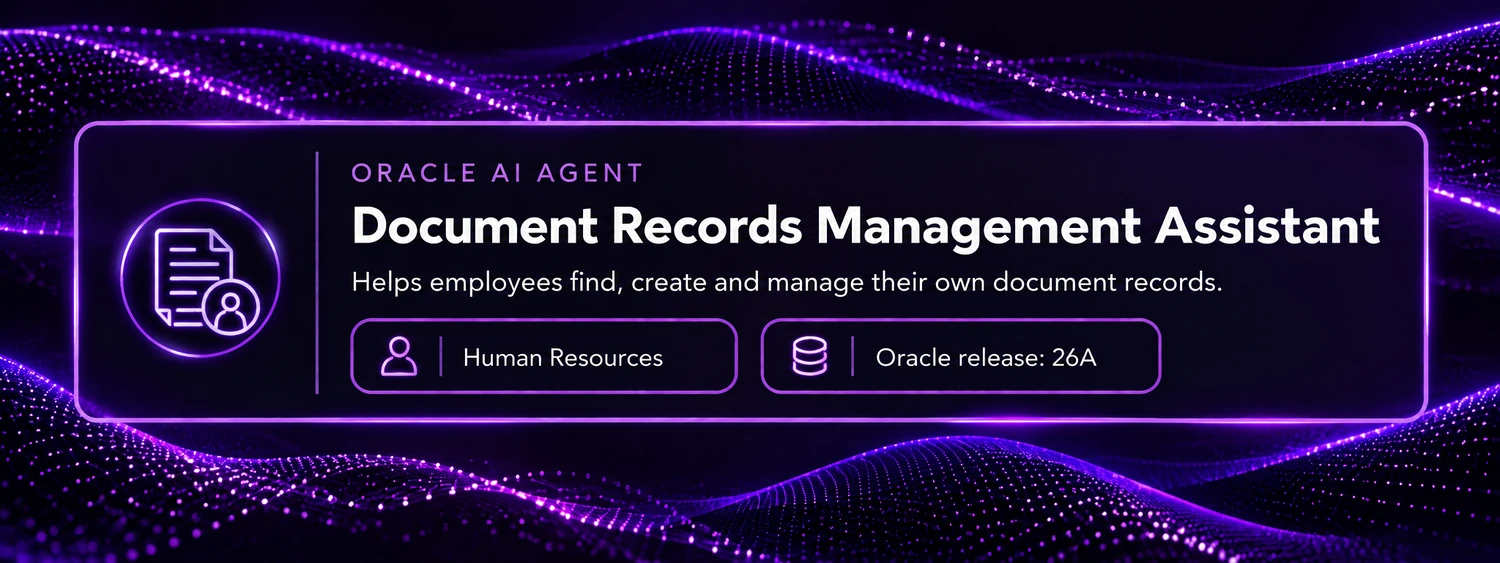
The Personal Information Assistant (now Person Data Assistant), covered in earlier articles in this series for its employee and HR Specialist self-service capabilities, now moves beyond retrieval into active transaction support: creating, updating, and deleting personal data within the conversational experience, subject to role-based access controls. The Jobs Assistant supervisor agent was introduced in 26B to streamline job creation through a conversational interface. In 26C, Oracle introduced the enhanced workflow agent Jobs Management Assistant, with support for viewing, updating, and managing existing job records, identifying missing or outdated information, and guiding users through validations without navigating multiple screens. The enhanced workflow agent Document Records Management Assistant was delivered in 26B, extending the 26A self-service supervisor version to Line Managers and HR Specialists.
The Journeys capability is arguably the most operationally significant 26B development for organisations that have invested in Journey design. AI can now trigger workflow agents automatically when a Journey task is completed or saved, meaning downstream actions like notifications, system integrations, and approval initiations execute immediately and consistently, without manual follow-up. For organisations with high-volume onboarding, offboarding, or lifecycle journeys, this changes what is possible without custom development.
A Note on What Is Coming
Two developments announced in early 2026 are worth naming here, because they affect how organisations should think about their AI roadmap, even if they are not yet the starting point for most deployments.
Oracle Fusion Agentic Applications, announced in March 2026, represent a genuinely new category: coordinated teams of specialised AI agents that pursue defined business objectives end-to-end, reasoning continuously, progressing routine work within governance guardrails, and surfacing only the exceptions and decisions where human judgement is needed. The HCM-specific Workforce Operations Command Center coordinates scheduling, time, and absence, surfacing real-time risks, simulating downstream impact, and guiding coverage decisions to help maintain service levels and control labour costs. This is not an extension of existing agent capability. It is a different model of how AI participates in work. Designing for it requires a higher level of process standardisation and governance clarity than individual agent deployments. Articles later in this series will address what that preparation looks like in practice.
AI Agent Studio, also maturing rapidly across 26A and 26B, gives organisations the ability to build their own agents and multi-agent compositions against Fusion data, within Oracle's security and governance framework. For organisations with use cases not covered by Oracle's seeded agents, this is now a realistic option rather than an advanced experiment. Again, this is covered in more depth later in the series.
Both are worth tracking. Neither should displace the more immediate question of where in your current Oracle HCM environment the process conditions are right for AI today.
Applying the Framework: Sequencing AI Across Your Organisation
The sequencing principle is consistent across all domains: start where the conditions are strongest, establish a measurable baseline, demonstrate value, and build from evidence.
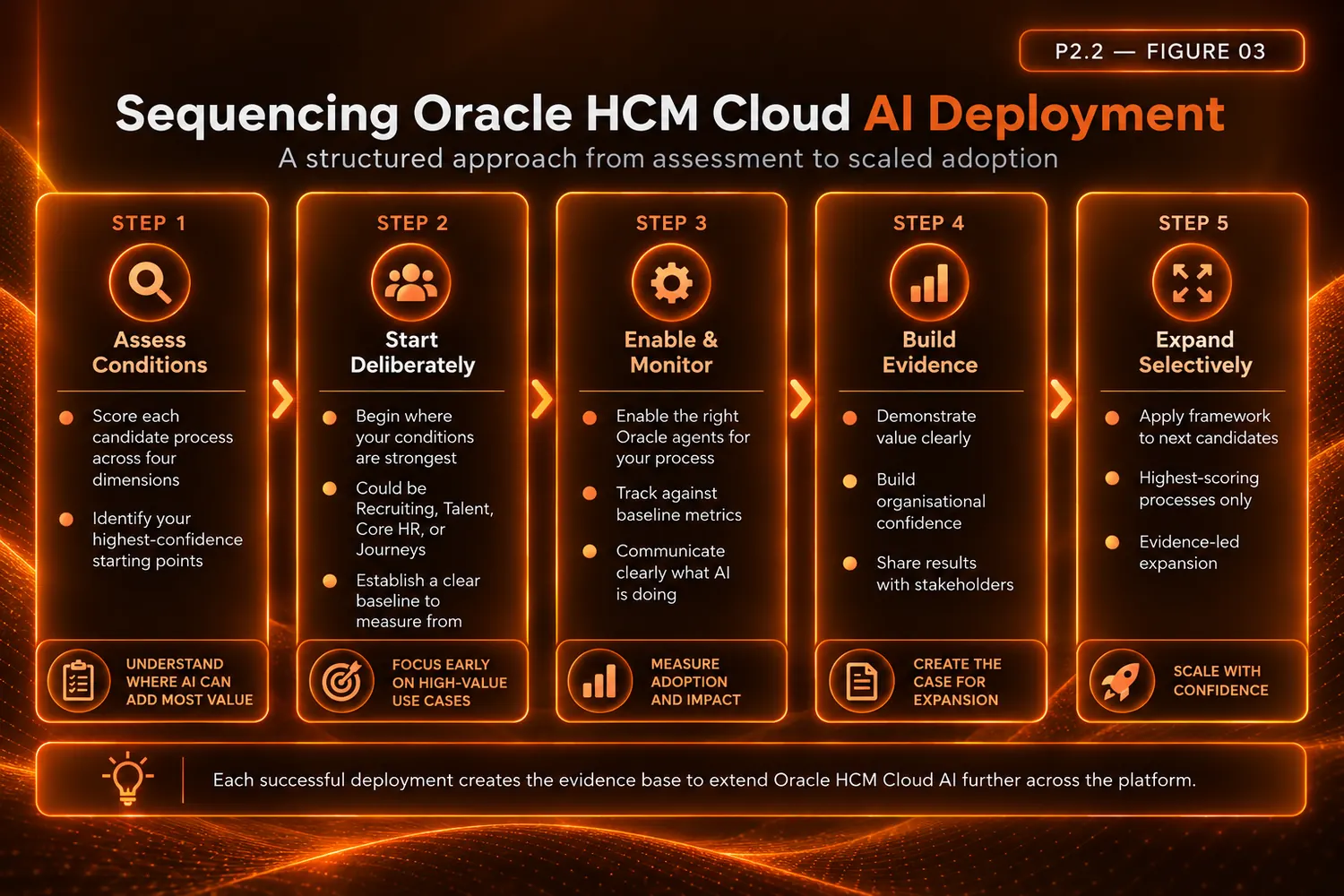
Swipe horizontally to inspect this figure.
Before enabling anything, identify what you will measure. For Recruiting, that might be time to first review, shortlist quality, or time to hire. For goal management, it might be goal completion rates at cycle open, or the quality and specificity of manager evaluations. For Journeys, it might be the time between task completion and downstream system notification. These baselines do not need to be sophisticated. They need to exist before the AI goes live, so you can demonstrate the difference it makes.
Each successful deployment creates the evidence base and organisational confidence to extend AI further. The platform is growing quickly. The framework for deciding where to apply it does not change.
Implementation Considerations
Run the framework before you enable anything
Apply the four dimensions to your candidate processes before making any feature decisions. The question is not what Oracle has available. It is where your organisation's process conditions make AI investment proportionate. Two organisations with identical Oracle licences should reach different starting points if their process maturity, data quality, and operational priorities differ.
Establish a baseline first
The most common implementation mistake is enabling AI without a way to measure its effect. Identify your key metric for each process before go-live. Track it for a quarter. Then enable the AI capability and track again. Without a baseline, you are creating an anecdote rather than a business case, and anecdotes do not sustain investment.
Communicate what AI is and is not doing
Managers, recruiters, and HR teams perform better with AI when they understand its role. AI Assist and Oracle's seeded agents are designed to surface signals, reduce friction, and accelerate the point at which the right decision gets made. They do not make decisions. Where AI does progress work autonomously, as Oracle Fusion Agentic Applications are designed to do, being explicit about what triggers automation and what is escalated to humans builds the trust that drives adoption.
Oracle ships new AI capabilities with every quarterly update. The capabilities described here reflect Release 26B. The framework for assessing where to apply them does not change as the catalogue grows.
The question this article started with, where does AI genuinely improve how work gets done, has a consistent answer across every domain. AI improves work where volume, complexity, frequency, and risk combine to make human attention the constraint. The framework makes that assessment explicit so organisations can invest proportionately rather than reactively.
Oracle's AI catalogue has grown to the point where the selection decision matters as much as the enablement decision. Start where the conditions are right. Measure from the beginning. Expand from a position of demonstrated value. That approach works regardless of which process you start with, and it works as Oracle continues to ship new capability each quarter.
AI Agents: Preparing Organisations for AI
In the next article, AI Agents: Preparing Organisations for AI, the series addresses the organisational conditions that must exist alongside technical and system readiness, process ownership, governance, and the operating model changes needed to deploy AI reliably at scale.
We'll explore:
- Why process ownership must be defined before AI deployment begins
- How governance structures shape AI reliability in practice
- What workflow maturity means when moving toward agentic applications
- How to align Oracle HCM Cloud AI with your HR operating model
Selecting the right processes and building the business case are necessary first steps. Sustaining that investment at scale requires the organisational conditions the next article examines.
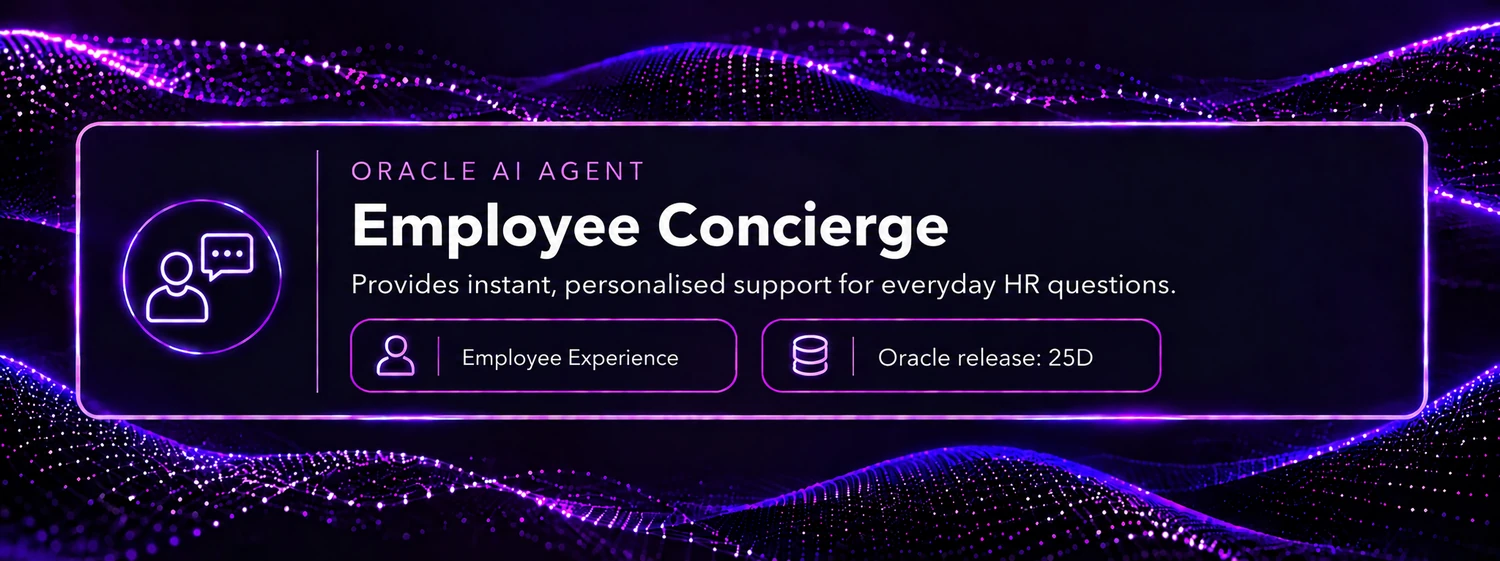
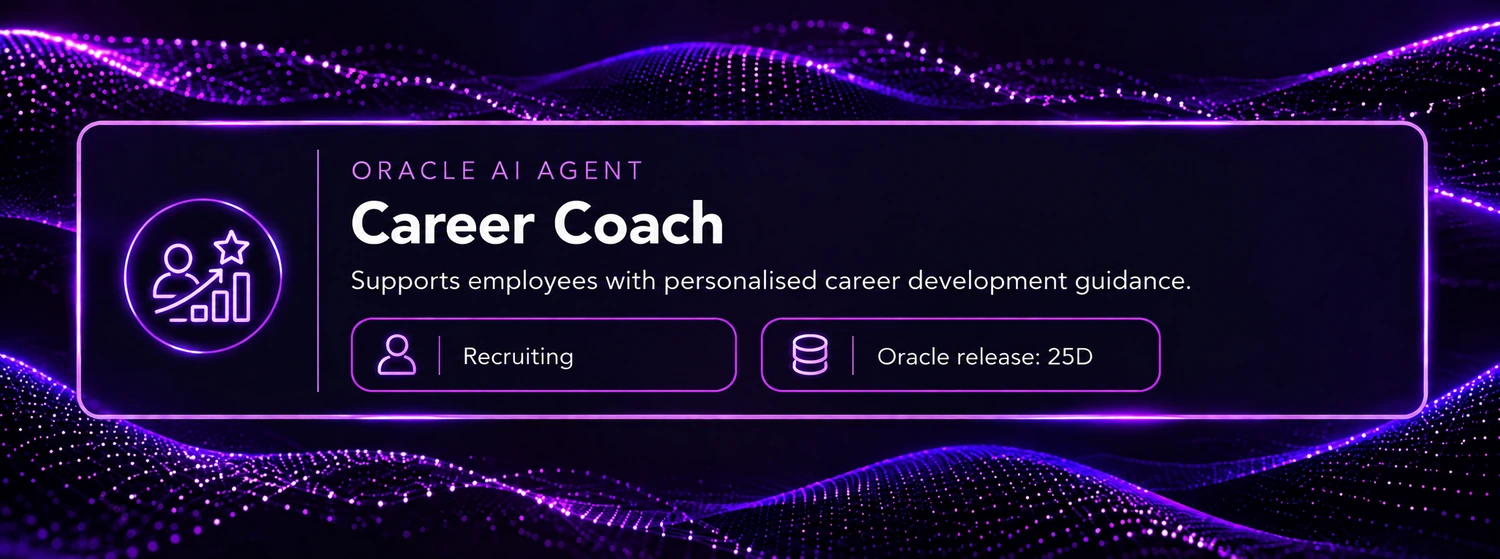
Oracle AI Agents Discussed in This Article