The answer is that technical and system readiness are necessary but not sufficient. AI delivers lasting value only when the people, roles, governance structures, and operating model surrounding it are aligned to support it.
Article 4 established the technical foundations for reliable AI deployment: clean data, consistent security, standardised processes, and Redwood maturity. Article 5 addressed where to invest, a framework for identifying the HR processes where AI creates genuine value before committing to an enablement sequence.
This final article in Phase 2 addresses what organisations most commonly underestimate. Systems can be technically ready. Use cases can be well-chosen. And AI can still fail to change behaviour, because the organisation itself is not prepared to work with it.
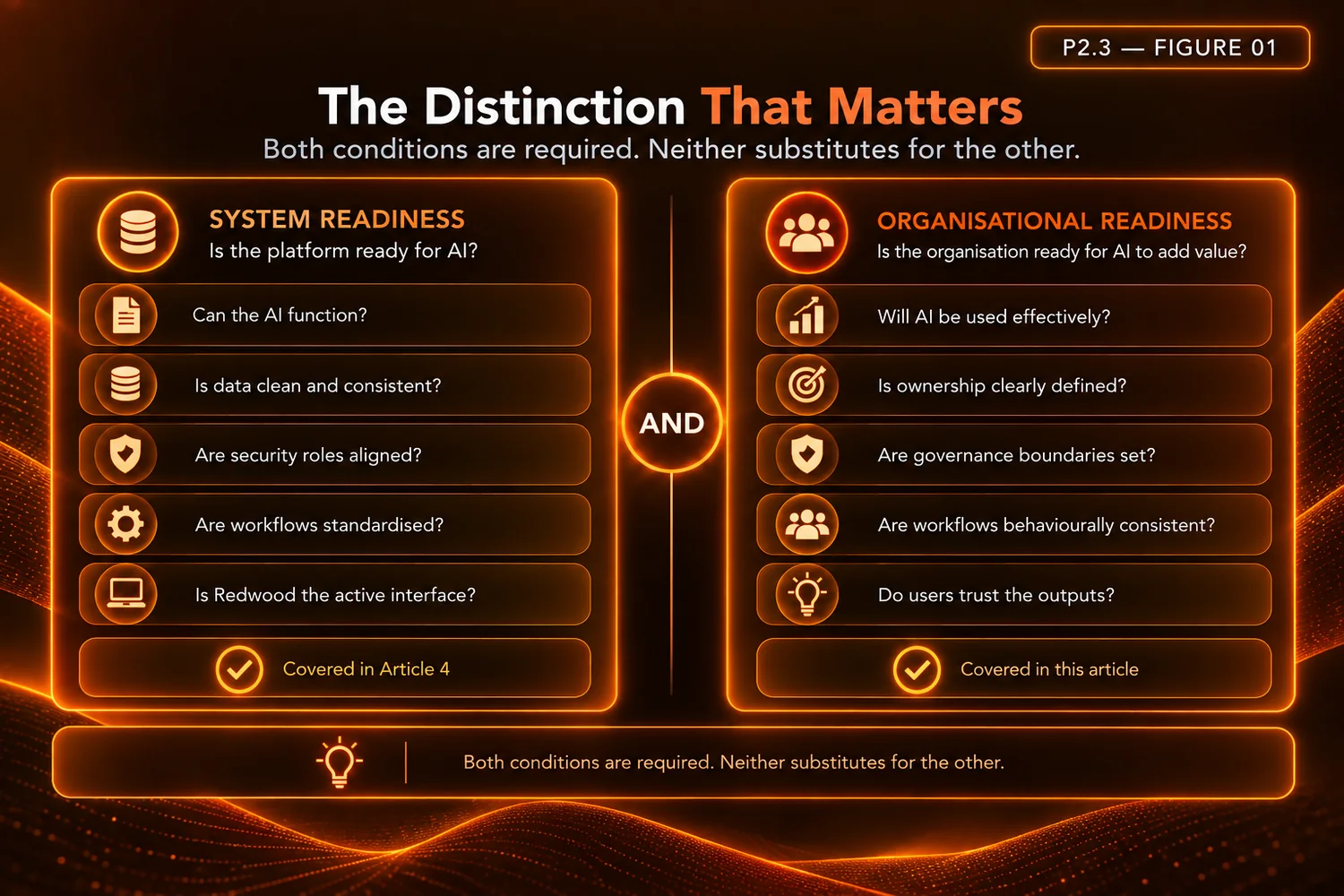
The Distinction That Matters: System Readiness vs Organisational Readiness
System readiness, covered in Article 4, addresses whether AI can function. Organisational readiness addresses whether it will be used effectively, governed appropriately, and trusted by the people who encounter its outputs.
The failure modes are different. When systems are not ready, AI produces inconsistent outputs. When organisations are not ready, AI produces outputs that users do not understand, cannot question, and do not know how to act on. In the second case the capability may be performing exactly as designed. The gap is organisational, not technical.
The most common failure pattern is not that organisations skip organisational readiness entirely. It is that they treat it as something to address after deployment, a change management activity that follows technical go-live rather than precedes it. By that point the gaps are live in production: AI outputs with no accountable owner, governance incidents with no audit trail, users who have already decided not to trust guidance they cannot explain. Retrofitting organisational readiness after go-live is significantly harder than building it in. The five conditions below are not a post-launch checklist. They are a pre-launch gate.
Swipe horizontally to inspect this figure.
1. Clear Process Ownership
Every AI-assisted decision requires a named, accountable owner, not of the technology, but of the process it supports.
In most Oracle HCM environments, process ownership already exists in principle. Someone owns recruiting. Someone is accountable for absence governance. In practice, that ownership is not always clearly defined, consistently applied, or well understood across business units. When it is not, AI creates a new problem rather than solving an existing one: outputs are produced, but no one is clearly responsible for reviewing them, acting on them, or explaining them when questioned.
Oracle HCM scenario
An organisation enables Candidate Matching Ratings in Oracle Recruiting Cloud without defining how those ratings should be used. One recruiting team treats the rating as a shortlist and stops reviewing lower-rated profiles. Another uses it as a starting point for structured review. Neither team is wrong in isolation, but the inconsistency creates fairness and governance risk that no one is monitoring, because no process owner has defined expected behaviour or has the remit to identify the inconsistency across teams.
Ownership gaps surface when AI outputs are questioned. If no one can clearly explain how an AI-assisted recommendation was produced, or who is responsible for reviewing its accuracy, the process lacks an effective owner.
- Each AI-assisted process has a named owner with authority to define how outputs are used
- Process owners understand what AI signals mean, functionally, not technically
- Ownership is consistent across business units, not concentrated in one region or team
- Escalation paths exist for contested or unclear AI guidance
2. Governance Structures for AI
AI must be governed like other enterprise systems, with defined decision boundaries, visible audit trails, and clear escalation paths.
Governance here does not require a separate AI framework. It requires extending the structures that already apply to HR processes and data to cover the AI capabilities operating within them. Three conditions must be addressed within Oracle HCM before AI-assisted capabilities go live.
Decision boundaries
Organisations must be explicit about where AI assists and where human judgement is required. An AI rating can surface a strong candidate. An AI flag can identify an unusual absence pattern. In each case the AI is performing as designed, but the decision about what happens next must remain with a human. That boundary must be defined, communicated, and enforced through process design, not left to individual interpretation.
Audit visibility
When a decision is made in an AI-supported workflow within Oracle HCM, the organisation must be able to reconstruct what signal was surfaced, who acted on it, and what the outcome was. This is both a governance requirement and a practical necessity for identifying when AI guidance is drifting from expected behaviour over time.
Escalation paths
Users who encounter AI guidance that appears incorrect, inconsistent, or unexplainable must have a clear route to raise the concern. Without escalation paths, problematic outputs persist in workflows undetected. With them, organisations build the feedback loop necessary to address issues before they affect trust at scale.
Oracle HCM scenario
An organisation enables the Oracle HCM Jobs Assistant supervisor agent (26B) for HR Specialists to create and update job definitions. No governance boundary is set between AI-assisted drafting and confirmed job record creation. HR Specialists begin accepting AI-generated content without structured review, and over time job definitions diverge from the organisation's grading and benchmarking standards. Because no audit trail links job record changes to AI-assisted actions, the drift is invisible until a compensation benchmarking exercise surfaces the inconsistencies. The AI functioned correctly. The governance gap was organisational.
Governance gaps become visible when organisations attempt to respond to questions about AI outputs. If the answer to “why did the AI suggest this?” is unclear, or if no audit record can reconstruct the decision, governance is insufficient for the capability enabled.
- Decision boundaries are defined: where AI assists, where human judgement is required, where AI must not influence the outcome
- AI-assisted workflows produce a traceable audit record that can be reviewed and reported on
- Users have a clear escalation route when AI guidance is unclear or appears incorrect
- Governance responsibilities are assigned, someone reviews AI output quality over time, not only at point of enablement
3. Workflow Maturity
A technically standardised workflow is not the same as a behaviourally consistent one.
When HR specialists in different business units follow materially different approaches to the same transaction, completing tasks out of sequence, marking steps complete prematurely, or applying informal workarounds, the variability AI encounters is not in the system. It is in the people using it. The system workflow can be perfectly configured and AI guidance can still surface at the wrong moment, or not at all.
Oracle HCM scenario
An organisation standardises its onboarding Journey in Oracle HCM and enables AI workflow agents (26B) to trigger downstream actions automatically when Journey tasks are completed. In regions where the process is well-documented and consistently followed, the agents fire correctly and reduce manual follow-up significantly. In regions where teams have developed informal workarounds, completing tasks out of sequence or marking completion prematurely, agents trigger at the wrong point, creating downstream errors. The system configuration is identical across regions. The fix is change management and process reinforcement, not reconfiguration.
Workflow maturity issues appear in adoption patterns rather than system logs. If AI-assisted guidance works correctly in some teams but produces errors in others performing the same process, the root cause is usually behavioural inconsistency, not system configuration.
- HR teams across business units understand key workflows consistently, not just whether they are configured correctly in the system
- Process documentation is current, accessible, and actively used by the people performing AI-assisted transactions
- Informal workarounds that bypass configured process stages have been identified and addressed
- Change management activity is planned to support workflow adoption alongside capability enablement
4. Operating Model Alignment
AI should reinforce how HR work is designed to operate, not cut across service boundaries or surface guidance to the wrong people at the wrong point.
Most enterprise HR functions operate within a defined service model: HR specialists handle complex or sensitive transactions, shared services manage high-volume operational activity, managers execute people decisions within defined boundaries. When AI is introduced without reference to this structure, it creates friction rather than removing it. Capability intended for HR specialists may be technically accessible to shared services teams, creating access and governance exposure. Guidance that surfaces at the wrong service tier creates confusion about who should act and whether they have the authority to do so.
Operating model alignment requires mapping each AI-assisted capability to the role that will use it, the process it supports, and the service tier it operates within. This mapping often surfaces gaps that were not previously visible.
Oracle HCM scenario
An organisation enables the Oracle HCM Personal Information Assistant (now Person Data Assistant) (26A, enhanced 26B) for HR Specialists, allowing them to view and verify personal information for other employees and receive deep links to update pages, subject to role-based access controls. The assistant is technically available to all HR Specialist security roles, including first-line HR coordinators in shared services whose remit does not extend to updating personal data for others. Coordinators begin using the assistant to initiate updates they are not authorised to approve, creating workflow exceptions requiring senior HR review. A targeted role-based access review before go-live would have surfaced this gap.
Operating model misalignment becomes visible when AI guidance produces confusion about who should act on it. If users regularly escalate AI outputs to a different team rather than acting directly, the capability has not been aligned to the correct point in the service model.
- Each AI-assisted capability is mapped to the specific role and service tier it is intended to support before enablement
- Security and data visibility align to that mapping, AI cannot surface meaningful guidance if the user cannot see the data it depends on
- AI guidance does not cross service tier boundaries without explicit design intent and governance controls
- The HR operating model has been reviewed for gaps that AI adoption may expose
5. Building User Trust in AI Guidance
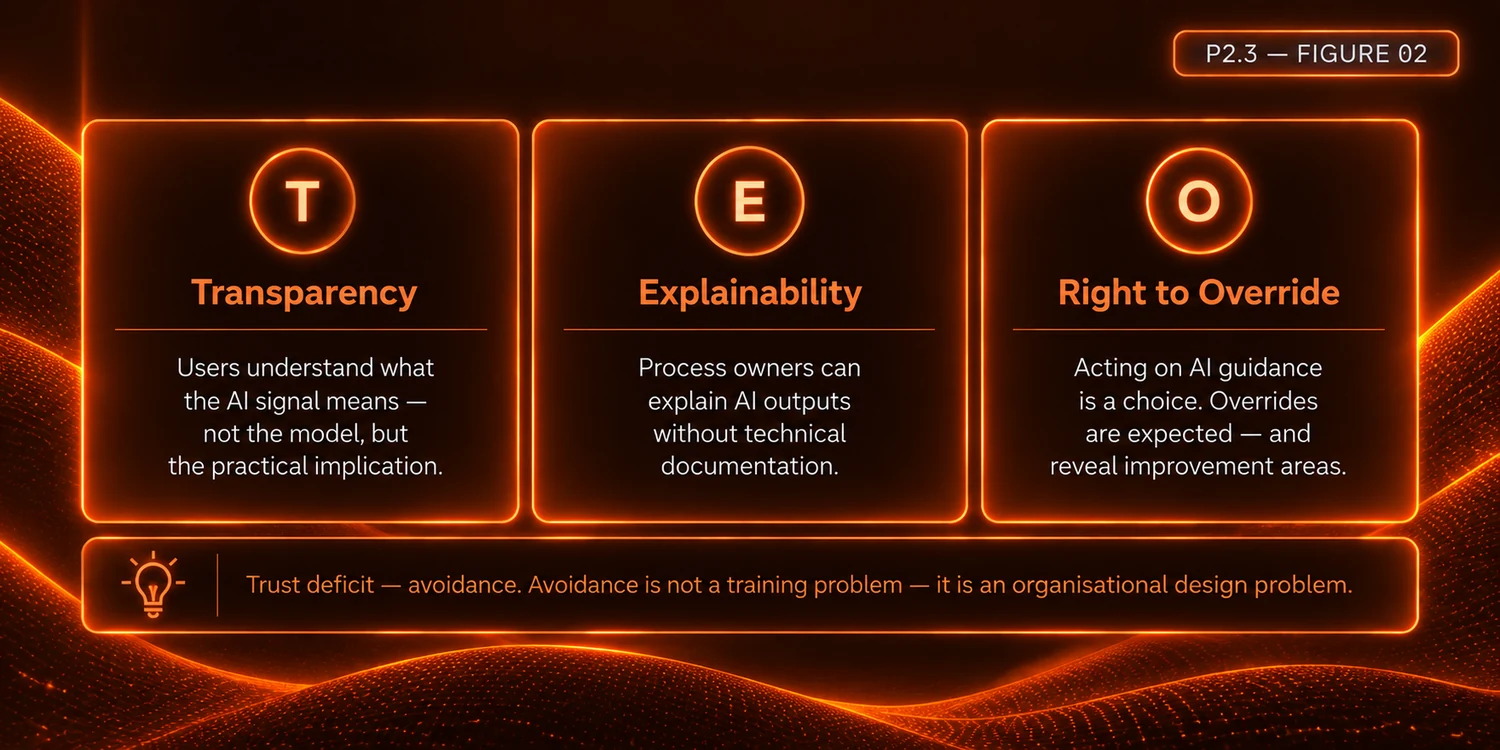
Trust in AI is not established by enablement. It is built through transparency, consistent performance, and the visible right to override.
Users who do not understand how AI guidance is produced will not use it confidently. Those who cannot question it will not trust it. In each case the capability exists but fails to change behaviour, and a capability that does not change behaviour does not deliver value. Three conditions must be addressed deliberately to build trust that sustains AI adoption over time.
Transparency: what the signal means, not how the model works
Users must understand, at a functional level, what AI guidance is based on. They do not need to understand the underlying model. They need to understand what the signal means in practice: that an Oracle candidate rating reflects alignment between a profile and requisition requirements, not a hiring decision; that an absence flag reflects a pattern in recorded data, not a judgement about intent; and that a Jobs Assistant supervisor-agent suggestion reflects standard job definition patterns, not confirmed accuracy. This removes the opacity that makes AI feel arbitrary.
Explainability: process owners must be able to explain outputs
When AI guidance is questioned, by a user, a manager, a candidate, or an auditor, someone must be able to explain it in non-technical terms. Explainability is not a feature of the AI itself. It is a function of how the organisation has designed and governed its use.
The right to override: and what overrides tell you
Users must know that acting on AI guidance is a choice, not a requirement, and that overriding it when their judgement differs is not only permitted but expected. Where AI guidance is systematically overridden by a particular team or for a particular process, that pattern is valuable information: a signal that the guidance may need to be reviewed, reconfigured, or retired for that context. Organisations that track override patterns develop a practical feedback loop that continuously improves AI guidance over time.
Swipe horizontally to inspect this figure.
Oracle HCM scenario
An organisation enables the Oracle HCM Team Goals Assistant for managers ahead of the performance cycle. The assistant surfaces AI-generated goal suggestions and evaluation prompts directly in the manager's Redwood performance pages. Managers have not been told what the suggestions are based on, whether they reflect prior cycle data, role benchmarks, or something else entirely, or whether they are expected to accept, modify, or override them. Several managers begin accepting AI-generated goal text without review because they assume it has been validated centrally. Others ignore it entirely and revert to their previous approach. When HR reviews cycle quality, goal consistency is worse than the prior year. The AI is performing as designed. The trust gap is organisational: no one explained what the Team Goals Assistant suggestions mean, what they are derived from, or that exercising judgement, including overriding the suggestion, is exactly what managers are expected to do.
Trust issues surface as avoidance. Users who do not trust AI guidance stop engaging with it, bypassing outputs, reverting to manual processes, or escalating decisions they are technically equipped to make. Avoidance is not a training problem. It is a trust problem.
- Users understand what each AI signal means and what it is based on, before the capability goes live
- AI outputs can be explained by process owners without reference to technical documentation
- Users know that overriding AI guidance is expected when their judgement differs. It is a design feature, not a failure
- A mechanism exists to capture and act on instances where AI guidance is consistently bypassed or questioned
Five Actions Before AI Goes Live
The five conditions above must be addressed in parallel with the technical and system readiness steps from Articles 4 and 5, not after deployment. Complete these in order before any AI-assisted capability goes live.
- Define ownership. Name a process owner for each AI-assisted capability with documented authority, responsibilities, and escalation remit before go-live.
- Set governance boundaries. Define where AI assists and where it must not determine outcomes. Assign audit responsibilities. Calibrate governance effort to process risk.
- Align to your operating model. Map each capability to the role and service tier it supports. Confirm security and data visibility. Resolve tier-crossing gaps before deployment.
- Standardise workflows behaviourally, not just technically. Identify informal workarounds that diverge from configured processes. Address them through change management before AI goes live.
- Prepare users, not features. Ensure users understand what AI signals mean, when to act, when to override, and how to escalate. This determines whether capability changes behaviour.
One principle worth applying across all five: treat the gap between system enablement and organisational readiness as a delivery risk, not an adoption afterthought. The technical deployment is the easier part.
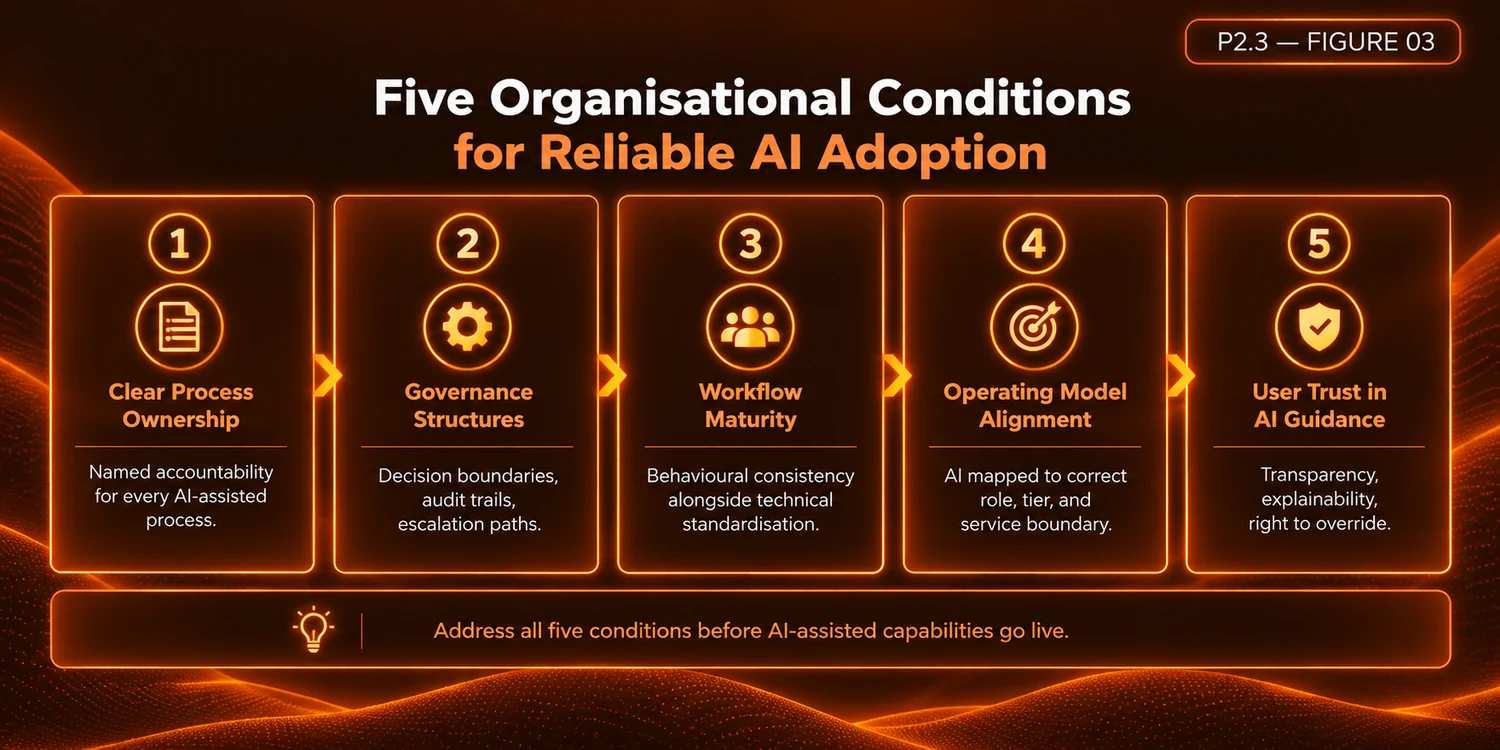
Swipe horizontally to inspect this figure.
Systems can be technically ready. Use cases can be well-chosen. And AI can still fail to deliver reliable value, because the organisation has not defined who owns the outputs, how they are governed, which decisions require human review, or how users are prepared to work with guidance they did not generate themselves.
The five conditions examined here, ownership, governance, workflow maturity, operating model alignment, and user trust, are not supplementary concerns. They are the organisational conditions that determine whether AI-assisted capabilities are used with confidence or encountered with uncertainty.
Closing Phase 2: What Readiness Actually Means
Phase 2 has examined readiness across three dimensions, systems, use cases, and organisation, and each has revealed the same underlying point. Getting one right without the others is not partial progress. It is a different kind of failure.
A technically sound system applied to the wrong process produces weak results. The right process on a sound system, inside an organisation that has not defined ownership or built user trust, produces outputs nobody acts on. Readiness is not a checklist completed in sequence. It is the alignment of all three conditions before capabilities go live.
That is what Phase 2 has addressed. Phase 3 moves to what comes next.
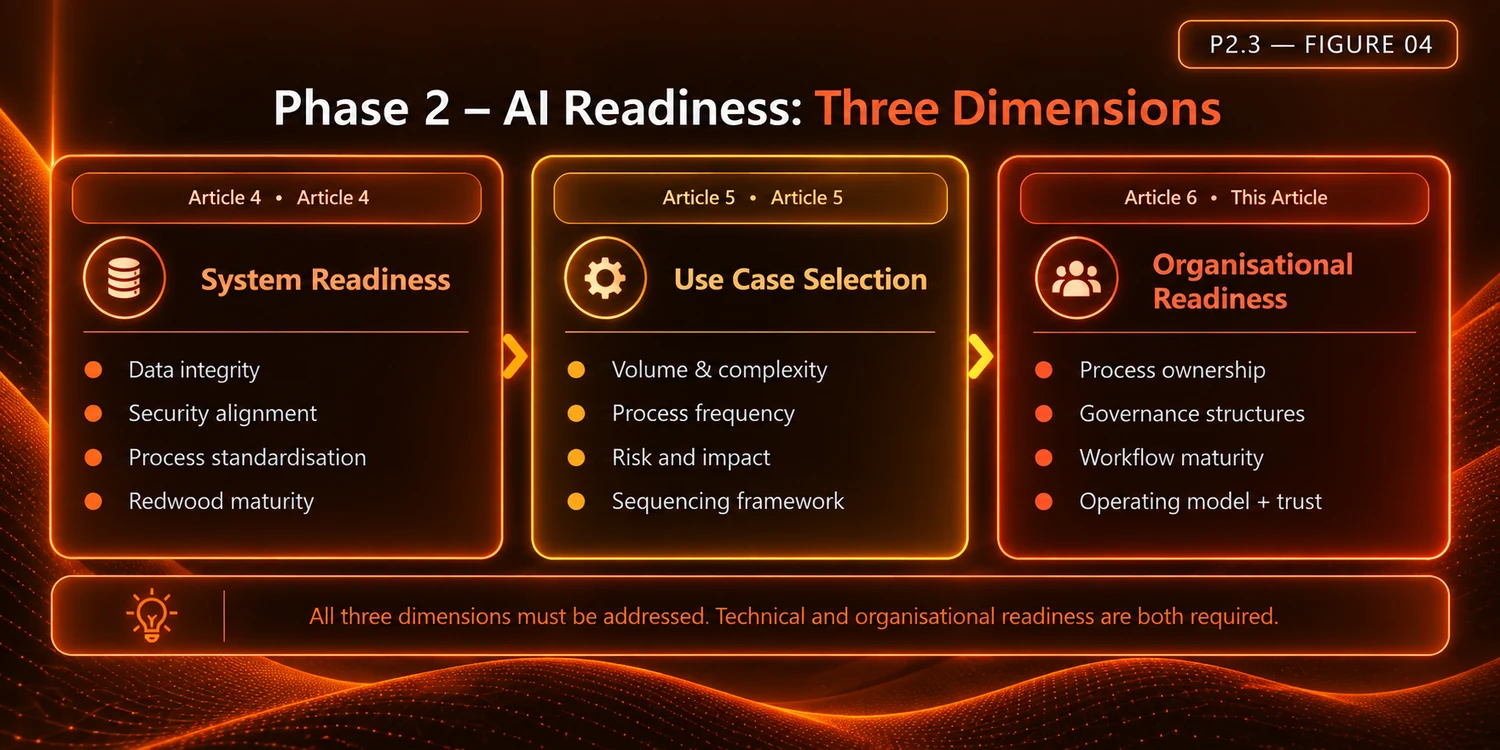
Swipe horizontally to inspect this figure.
The technology is ready when the systems are ready. The capability is ready when the organisation is ready. Deploying AI before the second condition is met is not acceleration. It is risk.
In the Next Phase
The series now moves from preparation to implementation.
In Phase 3 we'll start building, examining how AI agents are actually designed, configured, and deployed within Oracle HCM, and what makes the difference between an agent that delivers in production and one that only works in a demo.
Oracle AI Agents Discussed in This Article